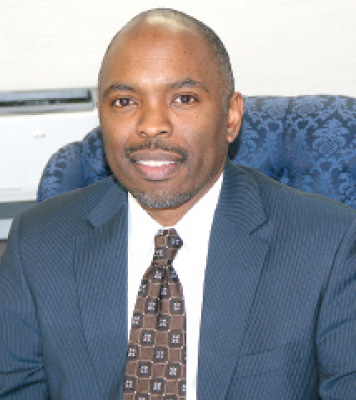
Mark A. Randon, the newly appointed federal bankruptcy court judge and the only African American in that role in the Eastern District of Michigan, is set to replace retiring bankruptcy judge Stephen Rhodes, who is currently hearing the Detroit bankruptcy case on the United States Bankruptcy Court.
Randon’s new position is of great importance, but to the 46-year-old judge it is a call to a higher duty in the federal judiciary.
And so when Judge Randon walked into my office Friday afternoon to discuss, among other things, his appointment and what this new elevation means for him personally and professionally and to the single mother who raised him, it occurred to me that he could have been hearing Detroit’s bankruptcy case, or any municipality’s for that matter, that would eventually fall into the same financial limbo as Detroit.
The role of a bankruptcy judge has carried more meaning in Detroit in the last 12 months than at any time in the city’s history. It shows the enormous influence a bankruptcy judge has in making decisions that could once and for all alter the lives of not only individuals but change the way companies and other entities do business. And in the case of Detroit, change the way the city is going to do business from now on.
An ever increasing number of people are paying close attention to the bankruptcy court, especially in the wake of Detroit’s Chapter 9 filing where pensioners are fighting to retain or at least get most of their hard earned benefits, at the same time creditors are hovering like vultures over Detroit’s assets.
That is why Judge Randon’s rise to the United States Bankruptcy Court from his initial assignment as a federal magistrate bears special significance and deserves the kind of attention in the public eye the bankruptcy court would not have gotten a decade ago.
And so as Randon, who has already started hearing cases, took his seat and opened up about his life journey that got him to the center of the federal judiciary, the weight of history behind him as the only Black bankruptcy judge in the Eastern District, I was encouraged by his zeal, determination and fidelity to the law. He wants to make a positive mark on the court.
By the stroke of a pen judges can change all of our lives, and that carries an even greater meaning in the federal judiciary.
“It has been a real blessing. Being the only African American bankruptcy judge I hope to encourage more diversity in the bankruptcy bar,” Randon said. “But I also want to let people in the community know that there shouldn’t be a stigma attached to bankruptcy if for some unforeseen economic reason you need a fresh start. That is what the system is there for, to give an honest debtor a fresh start and to pay creditors what is owed.”
Studies have shown that more Blacks are filing for bankruptcy, and Black women in particular, according to Black Enterprise magazine, are in a dire financial state, filing for bankruptcy and defaulting on student loans, forcing their retirement savings to disappear quickly.
“I want people to know that the system is there and that kind of relief is available. I hope we can take the stigma away,” Randon said. “These are credit implications but they are not lifetime implications. You can always start fresh.”
Because of the stigma that comes with filing for individual bankruptcy, some people think they don’t have that many options before the law.
“I do want people to know that if they happen to get into a dire situation honestly, that they do have options which would allow them to either work away from the debt entirely or make payments without the pressure of collections,” Randon said. “If people know that there are over a million of bankruptcy filings a year they will give the idea consideration even if it is not the best way to manage your finances.”
Despite a successful legal career that he said was punctuated by many struggles that forced him to change several jobs at different times, including working for the Detroit Public Schools and a stint on the 36th District Court, Judge Randon, born of Caribbean parentage, quickly credits his mother who raised him alone.
He repeated many times his mother’s role in his life, showing the deep affection between the woman who now resides in Atlanta and the son who would raise to become a federal bankruptcy judge.
“I was raised by my mother and she was always encouraging and supportive which was very uplifting,” Randon said. “She never allowed me to limit my possibilities and she always prayed for me, all of which helped me to get here. She is the biggest influence on my life.”
The University of Michigan Law School graduate said his mother’s advice growing up stuck with him and “part of what I wanted to do was to give back to her as a single parent who worked as a nurse. She did what anybody would do to protect and support their child.”
And when he applied for the position on the United States Bankruptcy Court to replace Judge Rhodes, a celebrated bankruptcy jurist, the lessons from his mother of never settling for less and going for greater possibilities was Judge Randon’s motivation.
“When I applied I thought it would be a long shot even though I had a lot of experience being a judge. I believe I had a good reputation, so I said why not? My mother always told me not to limit my possibilities,” Randon said.
He also praised the man whose seat he is now occupying in bankruptcy court.
“Steven Rhodes is a great judge. It is an honor to replace him. I look forward to it because the Eastern District is one of the busiest districts in the country, and one of the top districts for bankruptcy filings,” Randon said.
When I asked Judge Randon about his take on the ongoing bankruptcy proceedings with the City of Detroit he offered this: “I live in Detroit just like everybody else. I’m paying attention to what is happening. I hope that Detroit can emerge from this and become a better place to live and work.”
He understands the impact his decisions will have moving forward on anyone who comes before him.
“The stakes are high on a federal level and our role as judges is something we have to take very seriously. You can’t be cavalier about it. It may not be a big decision to you but it is someone’s life. The decisions have great impact,” Randon said.
“It is my responsibility to give everyone a fair chance to be heard. Even if they lose the case they have been given the chance to be heard. My obligation is to be thoroughly prepared and to give people an opportunity to be heard without prejudice.”
That is why the new bankruptcy judge said he had been preparing for months before his appointment, as he now tackles every case coming before him.
And how have the other men and women in Black robes in the United States Bankruptcy Court responded to their newest colleague?
“My colleagues have been extremely helpful, very welcoming and gracious. I don’t feel at all like an outsider. Everybody helps and supports each other,” Randon said.
Bankole Thompson is the editor of the Michigan Chronicle. Email bthompson@michronicle.com or visit www.bankolethompson.com.
About Post Author
