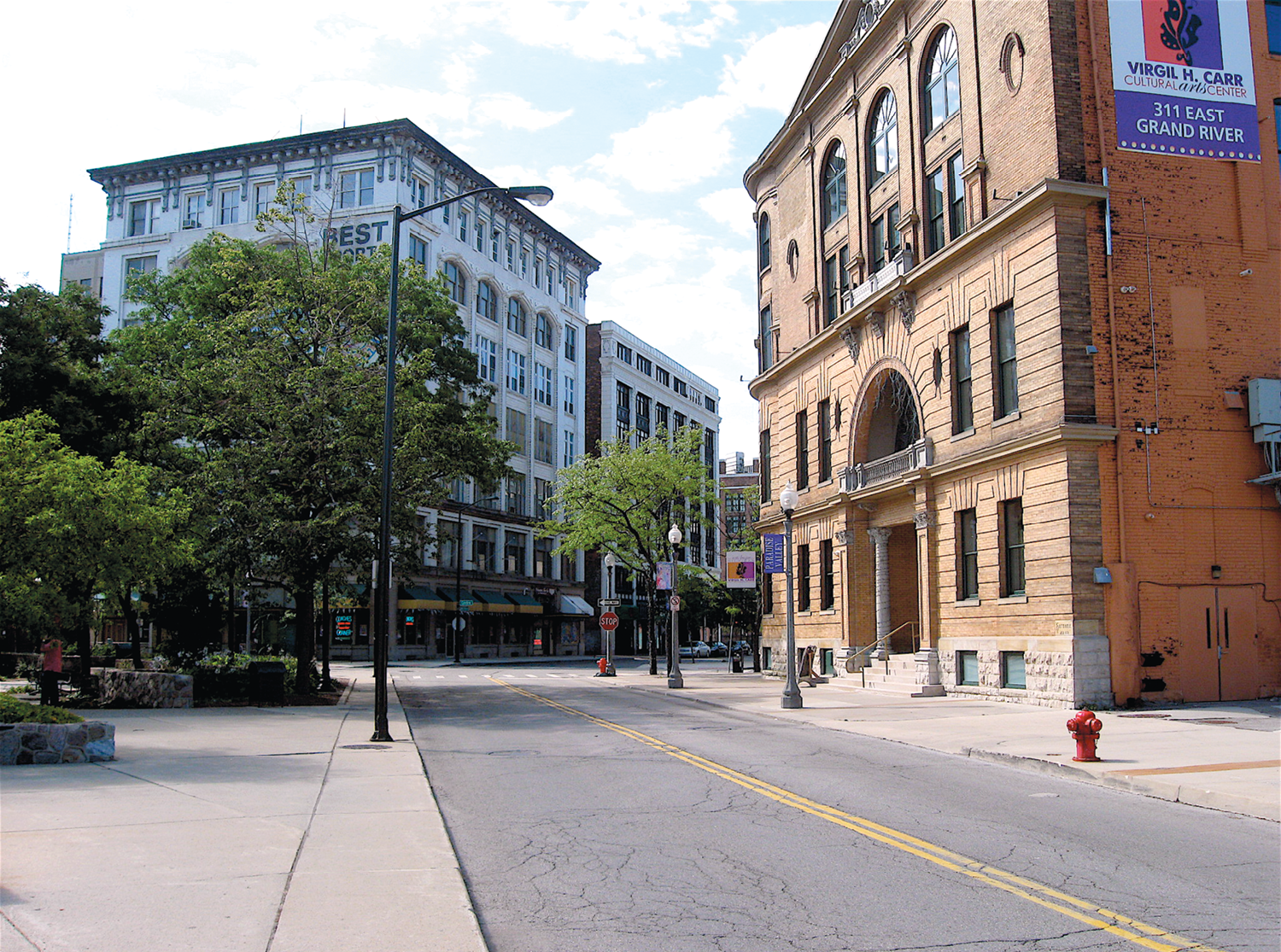
Oliver Ragsdale’s background spans cities in three states, but he is firmly rooted in Detroit as president and artistic director of The Carr Center in downtown Detroit, providing exhibits, performances and instruction in all the arts.
The Carr Center occupies the 1895 Harmonie Club building, located where East Grand River ends at Beatrice Buck Park (Harmonie Park). The beautiful three-story yellow brick building is just around the corner from Madison Avenue’s Opera House, Detroit Athletic Club, Gem Theater and Music Hall.
The center’s parent organization, The Arts League of Michigan (ALM), is dedicated to developing, promoting, presenting and preserving the African and African-American cultural arts traditions within our multicultural community and making the arts an integral part of life in metro Detroit.
ALM has been doing so in venues all over the metro area since its founding in 1991, becoming much more visible since establishing The Carr Center in 2009. At the center, ALM continues to offer arts classes for youngsters ages 7 to 18 in creative writing, dance, theater, photography and especially jazz and visual arts. Classes for adults have been added.
The Carr Center also regularly presents established artists, emerging artists and students in art exhibits as well as music, dance and theater performances, in its first floor galleries and second floor spaces. Additionally, the grand third floor concert hall with proscenium stage will soon be renovated.
The routinely cheerful Oliver Ragsdale, who prefers not to talk about himself, becomes openly joyful and emotional about matters touching The Carr Center and its mission. We asked him about the center and his relationship to and vision for the community.
What current projects at The Carr Center are exciting you?
In addition to our current programming, I’m excited about two aspects of our future planning. One face of this is “In Harmonie,” our master plan for the future of the center, developed in partnership with the University of Michigan’s Taubman School of Architecture and Urban Planning. That written plan, which includes matters of physical renovation as well as future programming directions, will be released very soon. The other aspect I’m excited about is the diversity this planning and partnering represents.
What challenges are you facing?
The challenge with parking has been solved. Through partnership with Rock Ventures, we now have validated parking at a discount rate (yes, even on game days) at the Z Deck, the parking garage around the corner from us at Grand River and Broadway.
Our bigger challenge is diversifying. As to arts groups generally, I like to say, “My diversity is not your diversity. In other words, for some arts groups, increasing diversity means including more African-American artists and bringing in more African-American audience members.
For The Arts League and The Carr Center, it means broadening the audience and the artists and the donor base and the support network to include members of all ethnic communities, while maintaining our core mission concerning African-American cultural traditions.
How did your professional career develop and bring you to Detroit?
After college, I managed two symphony orchestras and a dance company and was an associate producer involved in taking a show to Broadway. For the 4H organization, I managed their Michigan youth arts program. I also played percussion professionally from time to time for orchestras and shows.
I came to Detroit to work for the Arts League of Michigan. The Arts League was first established primarily as a cooperative supporting Black performing arts groups, initially, the Brazeal Dennard Chorale, the Detroit Metropolitan Orchestra, the Detroit Jazz Orchestra and an African themed dance company. Highland Park Community College sponsored the project, with foundation support.
I was hired by HPCC to assist in that effort. Through time and circumstance, The Arts League’s focus shifted more to community engagement. We presented a variety of programs at venues all over the metro area through the ’90s and beyond.
What is your vision for the future? What neighborhoods do you expect to impact?
All of them. Our intent is for The Carr Center to become your home for the arts and to build an audience that includes all of Southeast Michigan. Ultimately we expect to impact everybody, globally as well as locally.
Where did you grow up and go to school? Where did you first begin learning your craft?
I’m originally from Pittsburg and attended public schools there. I’m a classically trained musician, a percussionist, starting in 4th grade. I earned my bachelor’s and master’s degrees in music from Duquesne University in Pittsburg. My master’s program had a strong business component, leading into arts management.
Who first inspired you, made you say, “I want to do that.”
My aunt took me to see “West Side Story” and I knew then I wanted to be part of something like that. I started percussion with lessons at the Boys and Girls Club on Saturday mornings. When I showed up for my first lesson, I had seen on TV the night before a Leonard Bernstein “Introduction to the Orchestra” program, and I had watched the percussionist playing snare drum. I imitated him as if I were seeing myself in a mirror, so when I came to my first lesson, I thought I had it locked, but I had my hand positions exactly opposite of what they should have been. But I eventually got it right.
Who mentored you?
Well, first of all my father who was very entrepreneurial. Later in life there were three men — one White, two Black. At Duquesne, I was an aide to Robert Shenkovitch, the assistant dean, and he really encouraged me, moved me into the arts management field.
In Detroit, Don Vest and Hilda Vest, who led Broadside Press after Dudley Randall, were very important to me. When I was brought in to the Arts League, Don was the first chairman of the board. The next chair, Virgil Carr, was like a big brother to me, a coach, a confidant and a counselor. He was president and CEO of United Way, but he agreed to serve as chair for The Arts League. It is only logical and appropriate that the Carr Center was named for him.
Who have you taught or mentored?
Mentoring and training is a large part of what we do and among the most rewarding. Amazing young Detroit jazz pianist Ian Finkelstein started here when he was 13, studied with Rick Roe. Others have come up through our jazz program. Many years ago I mentored a young dancer, Rovan Hill, and stayed in touch through his career. He now choreographs for the Alvin Ailey company, and one of the most moving moments of my life was seeing in the dance concert program that he had dedicated a piece to me.
About Post Author
