


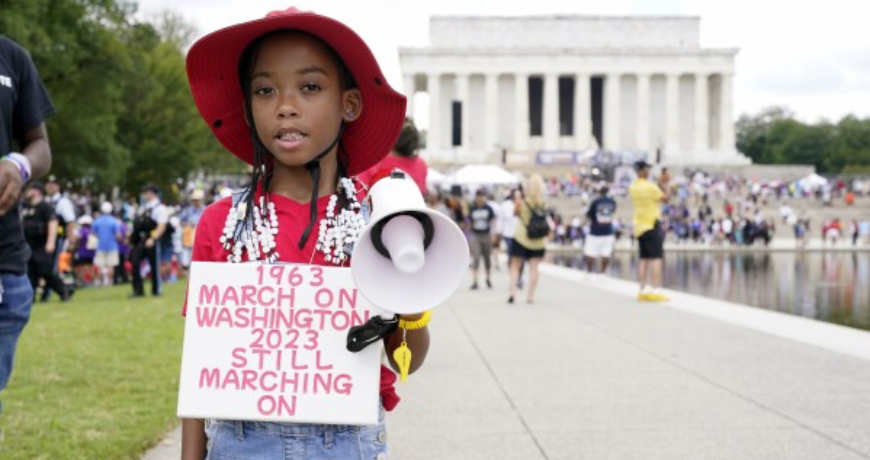
Photo credit: AP News
According to the Associated Press, thousands of people gathered on the National Mall in Washington D.C. on Saturday to mark the 60th anniversary of Rev. Dr. Martin Luther King Jr.’s historic March on Washington. The event was organized by the Kings’ Drum Major Institute and the Rev. Al Sharpton’s National Action Network and drew a multiracial, interfaith coalition of allies. Alphonso David, president and CEO of the Global Black Economic Forum, commented, “We have made progress, over the last 60 years, since Dr. King led the March on Washington. Have we reached the mountaintop? Not by a long shot.”
The original March on Washington, held on August 28, 1963, was a seminal event in the fight for civil rights, attracting as many as 250,000 people. It was instrumental in the passage of major civil rights legislation, including the Civil Rights Act of 1964 and the Voting Rights Act of 1965. Notably, the march had its roots in Detroit, where King led what was considered a rehearsal for the Washington event several months earlier.
This year’s gathering included a broader array of speakers and issues than the original march, signaling the evolving face of activism. Banners and speakers this year expanded the conversation to include LGBTQ rights and Asian American concerns. Pamela Mays McDonald of Philadelphia, who attended the initial march as an 8-year-old, noted the greater inclusion of women speakers. “Now look at how many women are on the podium today,” she said, according to AP.
For some, the day was bittersweet. Marsha Dean Phelts of Amelia Island, Florida, who was also present at the original march, expressed disappointment at the diminished crowd size and continued need for protest. “It was more fired up then. But the things we were asking for and needing, we still need them today,” AP reported she said.
Saturday’s gathering happened against the backdrop of modern life. The seriousness of the speakers was at times overshadowed by the casual activities taking place in close proximity, such as rugby games and people jogging and biking. Planes taking off from Ronald Reagan National Airport also intermittently drowned out the speakers, reflecting the rush of daily life that often obscures the ongoing fight for civil rights.
Martin Luther King III and his sister, Bernice King, visited their father’s monument on Friday ahead of the event. Bernice said she saw her father still standing in authority, signaling the fight for equality isn’t over. “We’ve still got to get this right,” she noted.
Rev. Al Sharpton stated that continuing to observe March on Washington anniversaries was a promise he made to Coretta Scott King, the late wife of Dr. King. “I never thought that 23 years later, Martin and I, with Arndrea, would be doing a march and we’d have less [civil rights protections] than we had in 2000,” Sharpton said.
The gathering served as a prelude to the actual anniversary on Monday, where President Joe Biden and Vice President Kamala Harris will meet with organizers of the 1963 event. All of King’s children have been invited to meet with Biden, White House officials said.
The event comes at a time when new generations are questioning the progress made since King’s era, often overlooking the hard-won gains that they benefit from today. Bernice King addressed this sentiment directly. “We can’t give up, because there’s a moment in time when change comes. We have to celebrate the small victories. If you’re not grateful, you will undermine your progress, too,” she said.
The March on Washington in 1963, wasn’t just a moment in history; it was a seismic shift in the American civil rights landscape. Reverberating far beyond the quarter of a million people who stood before the Lincoln Memorial, the impact of that day shaped a nation’s conscience and set into motion legislative changes that would affect generations to come. Dr. Martin Luther King Jr.’s iconic “I Have a Dream” speech laid the ethical framework for the Civil Rights Act of 1964 and the Voting Rights Act of 1965, key pillars of federal law that dismantled legalized segregation and disenfranchisement. But it wasn’t just about the laws; it was a societal awakening. The solidarity displayed by Black people and their allies forced America to confront its own declared values of freedom and equality, putting pressure on institutions, from political bodies to newsrooms to schools, to begin the hard work of living up to those ideals. While we grapple with the many ways America has yet to fulfill the promise of equality for all, the accomplishments triggered by that momentous day cannot be overstated. It redefined what was possible and reset the agenda for social justice in America.
As America remembers the impact of the original March on Washington, it’s clear that the struggle for equality and justice continues, albeit with new faces and new issues, but with a spirit that remains resolute in its quest for a more equitable future.