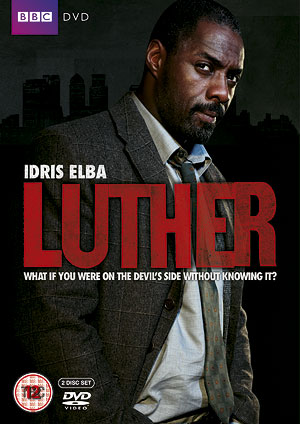
Detective Chief Inspector (DCI) John Luther (Idris Elba) spots the clues that everyone else misses. He’s also willing to play fast and loose with the rules if doing so catches a killer and protects the people of London.
One of the great things about DVD box sets is getting to see shows you might otherwise have missed. If not for DVDs, I might never have seen Luther, a BBC series created and written by Neil Cross.
To date, there have been two seasons (or series, as they say in the UK). The first consists of six episodes; the second, four.
The season one DVD set includes a documentary called Luther: The World of a True Maverick. In it, Cross said Luther combines two broad genres— the mystery or puzzle solving genre with the genius or lone maverick who puts together clues only he or she can see (Sherlock Holmes or Miss Marple); and the tradition of the “much more morally committed, much more beaten and bruised central hero figure”, best exemplified by Chandler’s Philip Marlowe.
Luther demonstrates his Holmes-like brilliance in episode one when he figures out that Alice Morgan (Ruth Wilson), the brilliant scientist daughter of a murdered elderly couple, is the killer.
The more rough-and-tumble aspects of Luther’s character are exemplified by such actions as his letting a serial kidnapper/pedophile fall from a great height at the start of episode one.
After that pre-credits sequence, we cut to seven months later. Luther is back on the job, the inquiry having found no grounds for disciplinary action.
We also learn he’s had a trial separation from his wife, Zoë (Indira Varma). As he tells his boss, Detective Superintendent (DSU) Rose Teller (Saskia Reeves), “I tried it; didn’t like it.”
He likewise doesn’t like it when he learns Zoë has started a relationship with a co-worker named Mark North (Paul McGann).
Amid this domestic upheaval, Luther investigates the Morgan murders; but with no evidence, he’s forced to let Alice go.
But he doesn’t give up. He figures out how she got rid of the gun, and confronts her with these facts. Unfortunately, owing to circumstances, he can’t prove anything.
Meanwhile, Alice has begun “investigating” Luther. Thus begins a complicated relationship between the two. He tells her he’ll plant evidence that someone else killed her parents if she doesn’t stay away from Zoë. He knows that while she’ll never admit to the crime, her ego couldn’t stand someone else being blamed for it.
“You’d degrade the law you serve just to protect some woman who cast you aside like offal?” Alice asks. When Luther says “in a second”, she asks how it can be love if all it does is make him lonely and corrupt.
Of course, Alice doesn’t stay away from Zoë. And in the third episode, she has Mark beaten up, with his attackers giving him the message “John says hello.” Given Luther’s temper, and a previous confrontation with Mark, everyone’s quick to believe Luther is responsible. This despite the fact that in episode two Alice showed up at the home Zoë and Mark share, just as Luther warned might happen.
As the six episodes of season one unfold and Luther investigates various crimes, he continues to interact with Alice, but he doesn’t let his co-workers— including his best friend, DCI Ian Reed (Steven Mackintosh) or his partner, Detective Sergeant (DS) Justin Ripley (Warren Brown)— know this. Thus, a violent outburst over the phone— which everyone assumes is directed at Zoë— paints a strong circumstantial picture against him when something bad happens later on.
During the course of his investigations, Luther does things ranging from the blatantly illegal (blackmailing the jailed father of a cop-killer to get the father to help stop the son; beating up a suspect to get a DNA sample) to the incredibly stupid (playing Russian roulette with a killer), all in the name of protecting the people of London.
John Luther has various personal and professional relationships, and according to Elba, in Luther: The World of a True Maverick, there’s a specific Shakespearean parallel between Luther and another character. I can’t mention which of Shakespeare’s characters without spoiling a surprise development near the end of season one.
In season two, amid the hunt for a serial killer who admires Spring-Heeled Jack and investigations of a series of attacks that at first glance appear to be hate crimes, Luther reluctantly agrees to help Caroline Jones (Kierston Wareing) the widow of a man he arrested years ago. According to her, he degraded and publicly humiliated her husband. Jones’ daughter, Jenny, (Aimee-Ffion Edwards) is selling herself on the streets, and worse. Jones blames Luther’s past actions for messing Jenny up.
Luther is reluctant to get involved because, as he says, “so many times I’ve tried to help people by doing things I shouldn’t have done, and it’s only made it worse.”
But he does try to help, in part because he sees Jones’ point. And things do get worse. To protect innocents, Luther is forced to both commit and cover up crimes.
Unrelated to those events, he also broke the law to help Alice. He felt he owed her one.
Some of his decisions were less than wise, but as it says on the season 2 DVD cover, “What if your own worst enemy was your own conscience?”
There’s, ah, just one more thing. In Luther: The World of a True Maverick, Cross said Columbo was an unlikely inspiration. “We took leaf from detective Columbo’s book and made it a how do you catch him.”
Elba said the audience knowing who the killer is early on lets them reach their own conclusions as to how the police should go about solving it.
“If you consider the procedure is right and Luther doing his own thing is wrong, then where do you sit, as an audience, knowing who the killer is already?” Elba asked. “What do you think the Luther should do, or shouldn’t be doing, in order to get the criminal?”
Elba also called Luther a modern spin on the maverick detective, and compared him to Batman. He described Luther as “a little less British, and a little more superhero than normal.”
As to the Batman comparison, I’m sure Luther could empathize with Bruce Wayne’s comment to Vicki Vale in Batman (1989): “my life is very…complex.”
If you had to describe John Luther in one word, “complex” would be it.
Copyright 2012 Patrick Keating
About Post Author
