

Random Musings – Return to Oz
By Patrick Keating
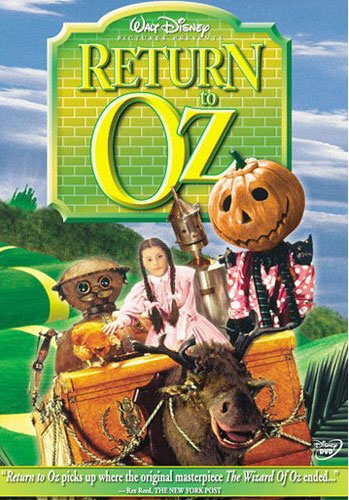

If I were to play a word association game and ask people what comes to mind when they hear the name “Dorothy”, I suspect that the vast majority would reply “The Wizard of Oz.” Probably more because of familiarity with the 1939 Judy Garland-led movie, which for decades was shown on TV every spring, than because of the books.
Likewise, I suspect that most people are also familiar with the key points of the story, whether or not they’ve seen the film.
On the other hand, I wouldn’t be surprised if few people are aware of the 1985 film, Return to Oz.
Which is too bad, because it’s a good film, one I wish my female cousins had been able to see during their formative years, because the Dorothy Gale (Fairuza Balk) of that film was a smart, resourceful, active participant in the action.
Recently, I re-read a Comics Buyer’s Guide column Peter David had written about that film. He had a lot of positive things to say about it, and I decided to get a copy from the library and see for myself if it’s a good as he said.
It is.
Unlike Garland’s Dorothy, who was, for all intents and purposes, a damsel in distress, Balk’s Dorothy often takes the initiative. Imprisoned by Princess Mombi (Jean Marsh) with Tik-Tok, the mechanical man who constitutes the entire Royal Army of Oz, Jack Pumpkinhead, and Billina the chicken, it’s Dorothy who concocts a plan to escape.
Balk, who was 9-years-old when Return to Oz was made, is also closer in age to the Dorothy of the books than Garland (16 when she made her film).
Return to Oz, which is based on the books The Marvelous Land of Oz and Ozma of Oz, (though how faithful it is to them, I don’t know, since I’ve never read them), isn’t a sequel to the 1939 film. Still, there are elements from that film, such as the ruby slippers and beings in Oz having analogs back in Kansas. It’s not a sequel because once she’s back in Oz, Dorothy finds her old house. At the end of the Garland movie, Dorothy wakes up in her bed, the house still very much in Kansas.
Return to Oz opens in October 1899, six months after the tornado. Aunt Em (Piper Laurie) and Uncle Henry (Matt Clark) are concerned about Dorothy, who keeps talking about this Oz place, and who hasn’t slept through the night since the tornado. They take her to a Dr. Worley (Nicol Williamson), who claims that the application of electricity will “cure” Dorothy of these “bad waking dreams.”
Like Aunt Em and Uncle Henry, Dr. Worley doesn’t believe Dorothy’s claims about Oz, even when she shows him a key she says was sent from to her on a shooting star (Aunt Em had dismissed it— with barely a glance— as having belonged to the old house). After Aunt Em leaves Dorothy at the “hospital”, Nurse Wilson (Marsh) has her strapped to a gurney and taken into the operating theater. Fortunately for Dorothy, when a lightning strike cuts the power, Worley and Wilson leave the room, and she’s freed from her restraints by another girl (Emma Ridley). Turns out I guessed correctly about her identity.
The two flee the grounds, but are caught in a flash flood. Awakening the next morning, Dorothy finds herself in a crate, in what’s little more than a pond, accompanied by Billina, a chicken from the farm. How Billina got there, given that the farm is many miles away, isn’t explained. Because Billina is now talking, Dorothy deduces that they’re in Oz.
Before long, Dorothy discovers the old house; the ruins of the Yellow Brick Road; and the ruins of the Emerald City, where several creatures, including the Tin Man and the Cowardly Lion, have been turned to stone. Soon after, she encounters Mombi. Learning that the Gnome King (Williamson) conquered the Emerald City and took the Scarecrow captive, Dorothy and company head in that direction when they escape from Mombi. Their plan: rescue the scarecrow.
How did Oz get in such a sorry state? Dorothy herself inadvertently caused it to happen.
Oh, and regarding Dorothy’s resourcefulness, it turns out the Scarecrow sent the key to her, confident she’d locate Tik-Tok, who was in a room accessed by said key. Tik-Tok said he was instructed to wait there for her.
Dorothy rises to the occasion when challenged by the Gnome King. She also refuses a chance to go home, because it would have left her friends in dire straits.
One thing David pointed out in his column is that unlike the revelation that the Wicked Witch of the West is vulnerable to water (which was never set up), the cause of the Gnome King’s defeat is set up. A subtle set-up, in my opinion, but it’s there. Even so, as in the 1939 film, Dorothy and company got lucky. In neither film did our heroes know that their adversary had an Achilles’ heel, much less what it was.
Another thing he pointed out (which he admitted he hadn’t thought of until one of his daughters mentioned it) is the very good question of why in The Wizard of Oz Dorothy didn’t turn the hourglass over again to give herself more time. I’d never thought of it, either; but had there been such an hourglass scene in Return to Oz, I’m confident the Dorothy of that film would have thought of it.
In fairness to Garland’s Dorothy, the 1939 film and the 1985 film were different types of movies made in different eras with different cultural attitudes regarding the capabilities of girls and young women. As a point of comparison, consider a scene in the 1940 film Dr. Cyclops, which I watched the same day as Return to Oz.
In Dr. Cyclops, Dr. Thorkel’s (Albert Dekker), experiments with rich deposits of radium have led to the discovery that he can shrink living matter. Four of his victims escape into the Peruvian jungle. Later, they discover a canoe, and work on using a makeshift winch with which to push it into the water. Well, three of them do. The female member of the party, Dr. Mary Robinson (Janice Logan), remains at their “cave”, apparently tending a fire. Is she tending a makeshift weapon in case Thorkel shows up? Nope. She’s not doing anything that, by story logic, requires her to be apart from the others.
Yes, her vantage point allows her to shout a warning about an approaching alligator (or crocodile, whichever), but maybe if she’d been helping with the canoe, they’d
have gotten it launched before the animal showed up.
Back to Return to Oz. In the end, Dorothy returns home (because she knows she’s needed on the farm, not because she’d been wishing to get home since she arrived); and although she still has no proof Oz exists, much less that she was ever there, she’s a much happier individual than the melancholy girl she was at the start of the film.
According to David’s column, Return to Oz was labeled as too scary for children by some critics. Don’t know if I’d agree with their argument. Yes, there are some scenes that a child might find scary, but, for a little kid, The Wizard of Oz wasn’t all songs and dances, either.
In short, this is a film worth seeing. See it if you’re an Oz fan; or if you’re a fan of Will Vinton’s Claymation™ and/or animatronics; or if you like films with smart, resourceful female protagonists.
Copyright 2011 Patrick Keating