

SPECIAL TO THE CHRONICLE
While countless stories of Detroit making an economic comeback continue to originate from local and national news outlets, for African-American entrepreneurs in Detroit, news accounts of such economic windfalls involving inclusion and diversity are often bleak. In a city that is more than 80 percent Black, and has more than 32,000 Black-owned businesses, many feel that the inclusion and diversity of minorities must increase significantly.
Many Black business owners in the city were highly encouraged, after attending the Bridges to Entrepreneurship Conference, held Friday, May 16, at Hotel St. Regis.
More than 150 Detroit headquartered and minority businesses were represented and ready to meet with Michigan’s largest road and bridge contractors as it related to $100 million that’s available with attending prime contractors, all of which have made strong commitments to facilitate diversity and inclusion with local Black companies.
Under the theme “Where Preparation Creates Opportunity,” the day-long conference, sponsored by Black Caucus Foundation of Michigan and The African American Commerce Center, began shortly after 9 a.m. when Michael Aaron, Black Caucus Foundation president and business manager, Laborers International Union, stood at the podium.
“This is an exciting day for me and should be an exciting day for you, as we roll out one piece of the puzzle for economy growth in the African American community,” said Aaron. “We have city government and some of the largest corporations in Detroit and the state, as well as prime contractors and banks present today. They are here to have an honest discussion about creating economic development and growth in the African-American business community.”
Dr. K.B. Stallworth, managing director of Black Caucus Foundation and chairman, USA-Energy Group, spoke about the importance of local entrepreneurship to the city’s revitalization and future.
“We are working very aggressively to have increased participation on multiple fronts as it relates to economy development for minority entrepreneurs in the city of Detroit,” Stallworth said. “We have to be honest, however, because when you look at a DBA contracts in road and construction, it’s not a game. You have to have access to capital.”
Stallworth continued: “People do business with people they know and trust. We have to be able to sell our businesses to the people who will buy and use our business products and services. However, prime contractors have to do a better job at finding people that they can work with.
“The contractors that are supporting this initiative today are the largest road and bridge building contractors in the state, and are saying, ‘what government can’t do, we will do on our own to demonstrate that we are interested in expanding this economy to assure that expansion is in all segments of the community.’”
Among the other conference speakers were Tony Thomczak, director, Supply Chain Management, DTE Energy; Louis Green, CEO, Michigan Minority Supplier Development Council; Len Becker, P.E. vice president, HNTB Corporation; Kelly Grant, HR director, Cadillac Asphalt; Pamela Moore, CEO, Detroit Employment Solutions; Triste Tice, vice president, Fifth Third Bank; Chris Poe, estimator, Ajax Paving Industries; Harvey Hollins, director, Governor’s Office of Urban & Metropolitan Strategies; Jim Doescher, vice president, Dan’s Excavating; and Darnell D. Jackson, Morgan Stanley.
Other banks represented were Independent Bank, Main Street Bank, Comerica Bank, Talmer Bank.
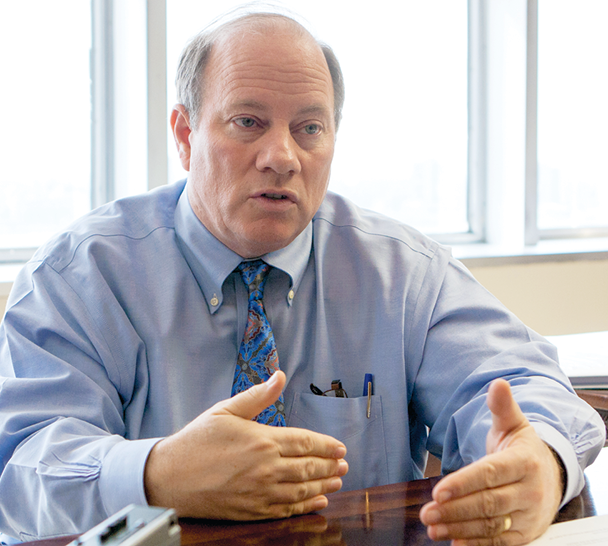
After an introduction by Jim Jenkins, CEO of Jenkins Construction, Mayor Duggan spoke to the entrepreneurs.
“You are here today, because you understand if we are going to grow economically as a city, we have to help each other; that is just reality,” Duggan said, speaking in broader terms of inclusion and diversity.
“We are going to announce very shortly that we have hired a director that will focus on building entrepreneurship throughout the city. If we are going to build the economy back up in this city, it’s going to be with entrepreneurs, like yourselves. If we support each other in this town, it will be much faster.”
The mayor also talked about a plan to step up the demolition of abandoned houses and commercial sites by convincing certain local companies to add demolition to their portfolios of service. He cited Jenkins Construction as one of the companies that now has demolition capabilities.
The mayor also outlined his plan for an experimental initiative with deconstruction services that will hire Detroiters.
“When we take these buildings down, we want to have a huge central warehouse for salvageable parts, like the windows, the doors, the floorboards and the bannisters,” Duggan said. “Can you imagine having companies that hire Detroiters helping to deconstruct houses and moving usable parts to warehouses where other people looking for parts to rehab houses can buy the parts?”
Following Duggan to the podium were other elected officials, including U.S. Rep. Gary Peters, State Rep. Thomas Stallworth and State Rep. Phil Cavanagh.
While many attendees viewed this conference as a positive step forward, numerous ones preferred to take a wait and see approach.
Many of the city’s top Black leaders, some of whom were not present, will continue to be advocates for compelling evidence that African Americans are a part of inclusion and diversity in significant numbers.
“There is more than $3 billion worth of public and private economic development and commerce activities in Detroit,” Ken Harris, president and CEO of the Michigan Black Chamber of Commerce (MBCC) continues to point out.
“Often contractors will contend that they can’t find qualified minority-owned businesses to do needed work for redevelopment and economic projects. However, we (MBCC) have amassed the largest Black and minority-owned business databases in the United States to assist in connecting Black businesses with contractors.”
Rev. Wendell Anthony, Detroit Branch, NAACP president, who remains concerned by the non-inclusion and non-diversification involving African Americans in many economic empowerment conversations, will continue his advocacy.
“We welcome new investments, construction and development at every level,” Anthony said. “However, we are compelled, and will continue to remind the governor, the emergency manager, the mayor, city council and anybody else, that ‘we want in.’”
