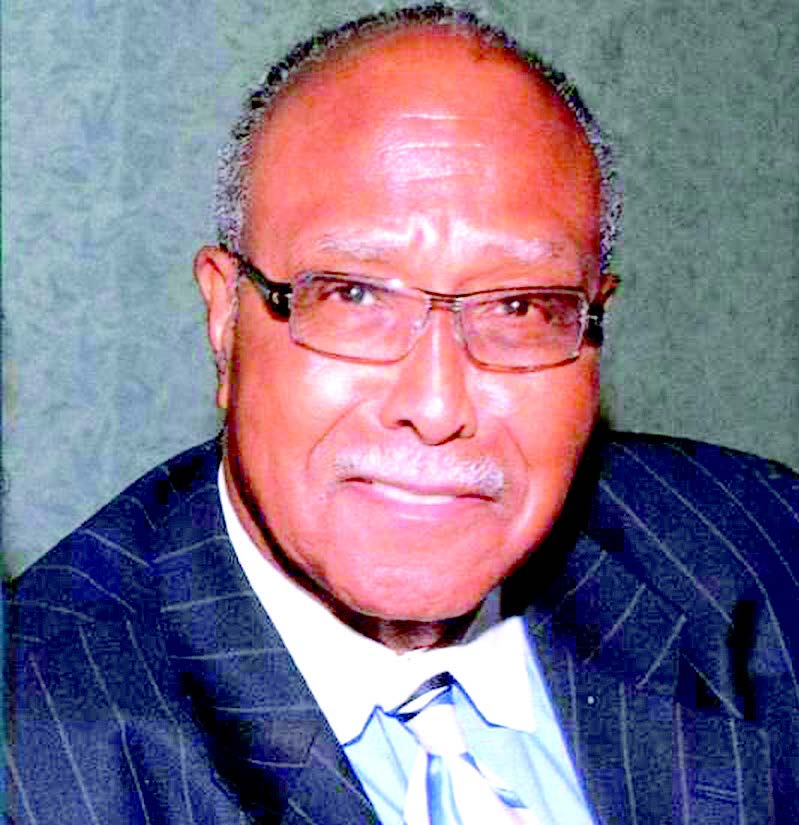
The Rev. Dr. Joseph Jordan, the former pastor of Corinthian Baptist Church in Hamtramck who will be laid to rest on Saturday, Feb. 15, is one of a handful of ministers I’ve come to admire for their integrity, tenaciousness and distinguished community leadership.
Whenever I met Rev. Jordan at functions or visited him in his office to discuss Hamtramck’s long struggle to end housing discrimination against African Americans who were being forcibly removed in that city, among other issues, the minister would first declare his affection for “those who buy ink by the barrel” and then proceed to talk about his appreciation for rigorous intellectual debate on the issues being propagated in the pages of newspapers.
He relished the discussion of history to measure our present state of affairs because to him it was an intellectually stimulating exercise, and a lesson to never repeat mistakes of the past.
The Hamtramck discrimination case occupied a special place in his heart because he played a significant role in addressing the injustice that was being done to Black residents. It was perhaps one of the biggest and most instructive moments of his life as an advocate.
For the Hamtramck case alone his name was etched in the Congressional Record, when the U.S. Senate in a tribute to him last April observed, “Pastor Jordan has been a tireless seeker of justice. Nothing exemplifies this better than his long years of work and advocacy to help resolve a housing discrimination case that dates back to the 1960s, the resolution of which has taken decades. Pastor Jordan and others never gave up on their community or on the idea of justice, and thanks to the hard work of many, and despite significant challenges, the case has been resolved.”
In our conversations I found Rev. Jordan to be an intellectual and an above-the-fray pastoral and community leader who understood the power of his role in society and what those charged with guiding a community ought to be doing to improve the lives of the unfortunate.
On the issues shaping the lives of Detroiters, Jordan was firm and did not mortgage his integrity in exchange for access to the trappings of political power. He was not impressed with the titles of politicians who came by his church or swayed by the politics of influence peddling and those who make their careers out of it.
Like the admirable and confident minister he was, Jordan approached every issue and debate with grace, dignity and with a keen listening ear. Like an old school master, he understood when to chastise and rebuke those he thought were misleading the community and when to acknowledge the good that was being done.
He was not one to seek the headlines even though the issues he was involved in such as access to health care for the marginalized and others were headline issues. Organizations and institutions sought his counsel, like Henry Ford Health System where he served as a member of its Board of Trustees.
But my respect for Rev. Jordan reached a new level in 2004 when in the midst of a fierce community debate about the state of the Detroit Public Schools, he rebuked former Detroit Mayor Kwame Kilpatrick during a Baptist Council meeting in the presence of the media and everyone who had showed up to watch the council vote on the school board decision.
Proposal E, as the ballot initiative was called, would have allowed Kilpatrick to choose the next leader of the board of education and the mayor was lobbying seriously to have the pastor’s group back his proposal.
A “yes” vote on Prop E would have resulted in a nine-member elected board with a CEO appointed by the mayor and confirmed by the board. A “no” vote would return school governance to its 11-member board with no interference from the mayor.
I recalled at the Baptist Council meeting when Kilpatrick and his entourage entered the church. It was as if Charles, the Prince of Wales, had just walked into the building. There were murmurs in the church that the mayor would make an appearance and hopefully that would sway the religious body which, at the time, was being led by Jordan as president.
Kilpatrick appeared and as usual gave a Shakespearean speech, a skillful and compelling presentation about why he needed to have a hand in the affairs of the Detroit Public Schools.
Jordan waited until Kilpatrick spoke and then it was his time to respond. He told the mayor it was interesting that he showed up when he needed support. Like the elder he was, Jordan spent a few minutes lecturing Kilpatrick on the bad optics of showing up at the council meeting as leader of the city only when he was in trouble. Then he proceeded to tell the mayor that their position against his proposal had not changed and would not be changed.
The remarks of Jordan came as a blow to the Kilpatrick administration and the mayor and his entourage left immediately.
Jordan was not afraid of whatever consequence he would be paying after that for publicly rebuking the chief executive of the city on the grounds of bad politics and disregard for the voices of the city’s ministers.
In politics, more often than not there is a price to pay for taking so-called powerful political leaders to task the way Jordan did Kilpatrick.
But Jordan, the boy who was born in Jasper, Georgia, and first began his career as a licensed electrician, before entering the ministry and earning degrees from Wayne State University, University of Detroit, Drew University and Payne Theological Seminary, was courageous, fearless and above all maintained a consistent and an undivided commitment to integrity.
Very few men and women can do what Rev. Jordan did in that meeting with the former mayor. That a humble man driven by his own conviction, holding the Bible in one hand and the Constitution in the other could call out the hypocrisy of political leaders is an attribute that is scarce today.
It is rare to see raw political power with all its effects being challenged so publicly by a man who was simply doing what he believed he was called to do: be a prophetic voice in the community.
It was also during his tenure as leader of the council that former Democratic leader and presidential candidate Dick Gephardt came to the council where he first unveiled his economic policy to the nation during his 2004 presidential run.
That is why his death leaves a challenge for the new council to demonstrate that it can exercise its responsibilities independent of political power. To show that it can make decisions that are community-grounded and in the interest of Detroit without being seen as capitulating to the trappings of political power, which can only be short-lived.
Detroit is going through a renaissance and Rev, Jordan, in the words of his close friend, Rev. Oscar King III of Northwest Unity Missionary Baptist Church, was “a renaissance man,” and he would want to see the council take center stage in some of the discussions around policy and quality of life issues affecting Detroiters.
The council cannot only exist in name and in fliers. In a Jordanian fashion it can use its influence and moral authority to challenge and impact policy in the city. There is no need for the council to take a back seat or opt for a mute position on the socioeconomic issues facing Detroit as it transitions to another chapter.
The leader of the Baptist Council should, in the footsteps of Rev. Jordan, show that Detroit, a city on the comeback, has a group of ministers equally concerned about the state of affairs and are vigorously weighing in on the debates affecting their congregants.
The 77-year-old Jordan did his part and left a legacy. Now it is time to take the legacy beyond what the council has been known for recently: endorsing politicians.
My hat’s off to Rev. Joseph Jordan, a man who talked the talk and walked the walk. I too will miss the man who fondly referred to me always as “Mr. Thompson” or “Mr. Editor” when he could simply call me by my first name, because he was Rev. Jordan, a man who defined his time.
Bankole Thompson is the editor of the Michigan Chronicle. E-mail bthompson@michronicle.com
About Post Author
