

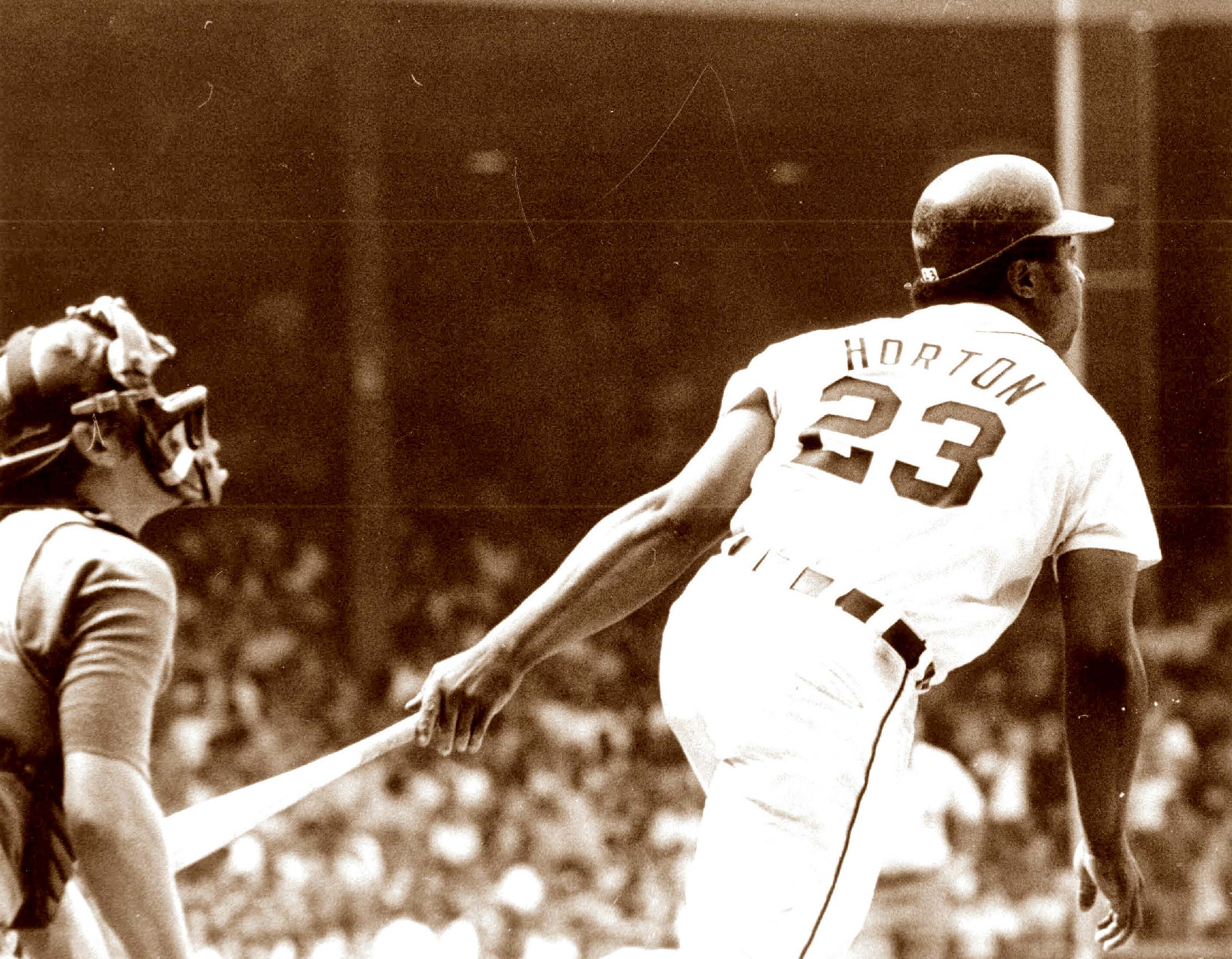
Willie Horton was the Detroit Tigers’ first Black superstar and enjoyed a magnificent career with the team from 1963 to 1977.
The outfielder would go on to play high-caliber baseball with the Texas Rangers, Cleveland Indians, Toronto Blue Jays and Seattle Mariners before hanging up his playing cleats in 1980.
While Horton had an illustrious career, which featured four All-Star appearances, a World Series ring, and a multiplicity of other baseball honors and accomplishments, many of his best moments in life were those spent with childhood chums in the Jeffries Projects on the city’s west side. This circle of friends was affectionately known as the Riff Raff Kids.
“The Riff Raff Kids started on the Poe school grounds and the Jeffries Projects about 60 years ago,” said Horton via phone from the Detroit Tigers’ training facility in Lakeland, Florida. “Through the years, we have stayed in touch with each other. There are not many days that pass that we don’t talk or get together at somebody’s house or gather for breakfast somewhere.”
Despite growing up in the Jeffries Projects in the 1950s, the Riff Raff Kids have all become productive citizens. “Some of the Riff Raff Kids grew up to become teachers, principals, automotive workers, doctors, lawyers, and professional athletes,” said Horton. “It’s unbelievable that from this group of friends we have been successful in so many walks of life. It’s also unbelievable how we have all kept up with each other through the years. It’s God who has kept us connected.”
Horton is not exactly sure how the name Riff Raff Kids was attached to his childhood circle of friends. Maybe it was given by adults living in the Jeffries Project, or maybe by Ron Thompson, who organized the Ravens, a Detroit sandlot baseball team that would be the platform from which Horton would begin to craft his baseball acumen.
“I don’t know,” Horton said with a laugh. “I think maybe we got the name because of the old television show ‘The Little Rascals.’ We were like that; we were always together, always doing fun things like playing sports.”
Some of the Riff Raff Kids played either recreational or organized baseball as youngsters. However, some played football, basketball and ran track. While it’s not possible to name all of the Riff Raff Kids, James Slate, Johnny Barnes, Walt Terrell, Herman Lee, Stanley Washington, Al Ford, Richard Mack, Reggie Chapman and Johnny Scarber were a few of this alliance of friends.
The Ravens was an integrated baseball team, which was rare in an era of blatant segregation in Detroit. Yet, this is where Horton learned about teamwork and playing with others, regardless of race, creed or color. These lessons would be valuable as Horton moved closer to playing professional baseball with the Detroit Tigers. Horton’s first few seasons with the Tigers was segregated times in the Motor City, and especially, when he went to spring training in Lakeland, Florida.
Horton credits Judge Damon Keith as being a significant person in shaping his life, both on and off the baseball diamond. Just before entering Northwestern High School in the mid-1950s, Horton’s father asked Keith to become young Willie’s legal guardian. Keith would go on to become young Horton’s mentor and legal advisor as well.
For Horton, baseball was his sanctuary and his passport from the Jeffries Projects. Walt Terrell had passport dreams as well.
“We were not going to let anything stop us,” said Terrell. “Just because we were raised in the projects didn’t mean we were going to be failures. Considering where we came from, we’ve all done pretty well.”
Terrell, a flame-throwing pitcher at Northwestern High School, graduated with Horton in 1961. Terrell was once scouted by the Washington Senators baseball team. After high school, he attended the University of Michigan where he earned both a bachelor’s degree in psychology and master’s degree in social work administration. He retired from the Detroit Board of Education as a standout teacher, psychologist and social worker.
Like Horton, Terrell credits much of his success to the Riff Raff Kids.
“We stayed together and pushed each other to be something in life,” Terrell said. “We considered each other family. That’s the glue that has kept us together for some 60 years. We have love and concern for each other, and we will still get into each other’s case if necessary.”
Horton agrees.
“We all grew up wanting to be somebody, wanting to be quality citizens in life,” said Horton who believes that there are about 20 Riff Raff Kids left. “We are just blessed to have this friendship that has spanned six decades. We are not going to let each other down.”
