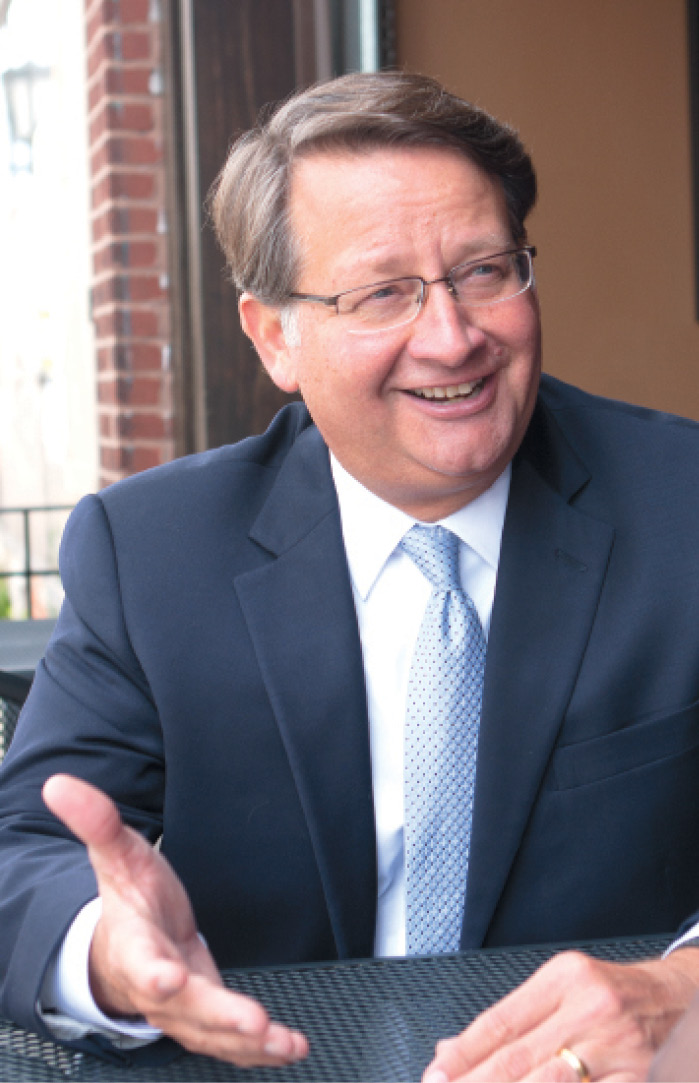
 (GARY PETERS, Democratic nominee for U.S. Senate, inside Tony V’s, one of the newest restaurants in Midtown owned by longtime Detroit entrepreneur Tony Vulaj. — Andre Smith photos)
Even as his Republican opponent, Terri Lynn Land, is cherry-picking media outlets to talk to, Congressman Gary Peters, the Democratic nominee for U.S. Senate, is making his case to anyone who will listen. In this interview, Peters goes one-on-one with Bankole Thompson, editor of the Michigan Chronicle, on a range of issues both policy and personal explaining why he should be the next U.S. senator from Michigan, replacing the iconic Carl Levin.
MICHIGAN CHRONICLE: What are the most pressing issues for the next U.S. senator from Michigan?
GARY PETERS: I am committed to building an America where anyone willing to work hard and play by the rules can find a good-paying job, have access to quality, affordable health care, live in a safe neighborhood, send their children to a good school, and at the end of the day, retire with dignity. I am focused on making Michigan a trade, travel and logistics hub; supporting small businesses and ensuring they have access to the capital they need to grow and create jobs; and promoting certainty in the federal tax code and incentivizing growth.
MC: Who convinced you to run for the Senate?
GP: My father was a World War II veteran and public schoolteacher and my mother worked as a nurse’s aide and union steward. They taught me from a young age that hard work and service are fundamental Michigan values and they impressed upon me a commitment to live up to them. That’s why at 34 years old, I joined the United States Navy Reserve and why I returned to drilling duty after the Sept. 11 terrorist attacks. I decided to run for the U.S. Senate because I am worried about what the future for Michigan is going to look like for my children and all of our families. We need Michigan’s voice in the U.S. Senate to carry on Sen. Carl Levin’s legacy and commit every single day to working for common-sense solutions to the kinds of challenges Michiganders struggle with around their dinner table. My top priority has always been about creating good jobs, investing in our engines of growth like small businesses, and making sure there is a ladder of success for middle class families and those aspiring to get there. It is critical that we protect the promise of the American Dream so that folks who work hard and play by the rules can find good jobs to support their families and retire with dignity.
MC: What has changed for you since you announced your run for this office?
GP: The amount of money the right wing has spent on defeating me has grown exponentially. My Republican opponent and her special interest allies like the Koch Brothers have attacked me with more than $12 million in negative advertising lying about my record. My opponent and her outside special interest group allies like the Koch Brothers have attacked me because I took on the oil billionaires that were contaminating our neighborhoods and our Great Lakes, and I will continue to fight to stop new tax breaks for big oil companies. Almost everything the special interests backing Land say in these negative attack ads is false, except for the fact that I voted for the Affordable Care Ac, and I am proud of that. I believe that we live in the greatest country on earth and that’s why every American should have access to affordable, quality health care. The Affordable Care Act is an important step in the right direction to make that a reality. I will never back down when it comes to doing the right thing for Michigan, and the Koch Brothers know it so they are doing everything they can to keep me out of the U.S. Senate.
MC: Your opponent said you invested in pet coke. Can you explain?
GP: I have been an outspoken opponent of the out of state oil billionaire Koch Brothers, especially when they illegally dumped their petroleum byproduct called pet coke into neighborhoods in Detroit and into our Great Lakes.
My opponent is trying to defend the Koch Brothers because they have spent over $6 million trying to buy this U.S. Senate election for her. My opponent is also trying to do anything to change the subject from controversies surrounding her personal finances that she refuses to answer.
My opponent is worth more than $30 million and she may be breaking the law to funnel millions to her U.S. Senate campaign. Yet, at the same time she has $3 million to fund her campaign, she only pays 2.2 percent in taxes — a fraction of what the average Michigander pays.
Here are the facts: I have investments for my retirement like many Americans and many of them have direct ties to Michigan like auto companies and other manufacturers. But I will always speak out against any company that tries to hurt our state, and I will always demand better of any company that threatens our neighborhoods, small businesses or the Great Lakes.
MC: Your opponent has refused to debate you. How should Michigan voters view that?
GP: This is the first open U.S. Senate seat in Michigan in 20 years and Michiganders deserve to hear from both candidates on the issues that matter most to them. Every election is about a debate of ideas, and voters deserve to hear the very different visions my opponent and I have for the future of our state and our nation.
That is why it is unacceptable for my opponent to hide behind millions of dollars in false, negative attack ads on TV and 30- second sound bites.
My opponent refuses to answer how, as the one of the wealthiest Senate candidates in the country, she pays only a 2.2 percent tax rate. She also refuses to discuss her agenda that gives the special interests bankrolling her campaign new tax breaks at the expense of our middle class. Michiganders deserve to be able to see both candidates answer questions and outline what their visions mean for our economy and our middle class.
It is the responsibility of Michigan’s next U.S. senator to be a vigorous advocate for our state in Washington, and debates are a way for voters to see which candidate will be the most effective. Back in June, I proposed a series of five town hall-style forums and encouraged my opponent to work together to work out a schedule.
I’ve accepted debate invitations from news organizations around Michigan, including two in Detroit. Unfortunately, already one debate in Grand Rapids has been canceled because my opponent would not coordinate with the organizers.
MC: How should Detroit voters view this election?
GP: This election is extremely important for voters in Southeast Michigan, especially in the city of Detroit where I am proud to be a congressman. Voters will be deciding the future of our city and our state. I believe that we cannot have a strong state of Michigan without a strong and vibrant Detroit, and the stakes for how we rebuild our city, our region and our middle class could not be higher.
My top priorities for Detroit are increasing access to capital for small businesses and startups; supporting next-generation manufacturing; and investing in infrastructure to make metro Detroit a trade, travel. and logistics hub. Expanding Detroit’s public transit is critical to developing a strong sense of community.
We must also build on Detroit’s legacy as the manufacturing capital of the country. I have been a strong supporter of the M-1 rail project and worked to deliver federal funding for the project. I believe that bringing this project online in a timely manner will be a critical step forward in revitalizing the core of Detroit. I also support the regional bus rapid transit system that is currently under development. The link between education and Michigan’s future economy is key. The earlier we invest in education, the greater return we will receive as parents, students and taxpayers. That is why I have and will continue to fight to protect early education programs like Head Start.
MC: Where do small businesses in Detroit fit into your list of issues to deal with, if you are elected the next U.S. senator?
GP: Small businesses are the engines of growth in our economy and will play an important role in revitalizing Detroit. I’m excited to see how Detroit has become a hub for innovation and startups. I’ve worked and will continue to work to spur this kind of innovation and help encourage more people to follow their dreams of owning a small business.
I helped introduce legislation that would invest in entrepreneurship, the Jumpstart Our Business Startups Act (JOBS) Act, and I want to continue working to help turn more entrepreneur ideas into successful businesses. I am a strong believer in public-private partnerships, and I want to make sure that Greater Detroit small businesses have access to the capital they need to grow and succeed.
I helped write two small business programs, the State Small Business Credit Initiative (SSBCI) and the Small Business Lending Fund (SBLF), that were signed into law as part of the Small Business Jobs Act. Since then, the SSCBI program has helped Michigan small businesses save or create more than 6,000 jobs. One great example of how this program has been a success is New Center Stamping in Detroit.
Not only was it able to get the critical funds needed to create jobs, they made it a priority to hire locally and hired 45 Detroiters. This year, I introduced the Small Business Access to Capital Act of 2014 to build off the success of the SSBCI program and invest in Michigan small businesses.
In the U.S. Senate, I will continue to work closely with the small business community and entrepreneurs.
MC: Does this Senate race warrant President Obama visiting and campaigning for you?
GP: I’ve joined President Obama twice this year when he’s visited Michigan to talk about issues that are critical to our state. I was especially pleased he chose to come to Michigan in April to speak about raising the minimum wage nationally. This is one of my top concerns – that folks who are working hard and working multiple jobs are still not earning enough to support their families. We need to raise the minimum wage in Michigan and at the federal level because many people are falling behind. I’d be encouraged to see the president come to Michigan again and specifically come visit Detroit because we need the positive stories about the city to get out there.
I think the president would be impressed with the strength and resiliency that’s driving the city forward. It also should be an opportunity for Michiganders to talk with the president, ask him questions, and talk about what our state needs from Washington.
MC: What is the clearest contrast between you and your opponent?
GP: My opponent and I have very different visions for Michigan, our nation and our middle class. I worked in business for more than 20 years and I served in the U.S. Navy Reserve before entering into public service, and I am focused on identifying common-sense solutions that reinvest in our economy and strengthen our middle class.
I am deeply committed to ensuring that the promise of the American Dream is there for anyone who works hard and plays by the rules so they can succeed. My opponent, however, is a multimillionaire who pays 2.2 percent in taxes and wants to pay even less. While I have supported boosting the minimum wage, she has supported tax cuts for billionaires.
While I fought to save our auto industry, my opponent to this day opposes the auto rescue — something that would have devastated our economy and our middle class.
I have fought to protect voting rights, while my opponent was investigated by the federal government for throwing thousands of voters off the rolls. Michiganders cannot trust my opponent.
MC: Your opponent is not polling well among women. Is that significant?
GP: On family issues like equal pay for women and health care, my opponent and I have very different views. She has lost trust with Michigan women because her record would set us back decades. She has said that women don’t care about equal pay, and she would vote against the Paycheck Fairness Act. She also supports the Hobby Lobby decision that lets bosses refuse to cover birth control, thereby making decisions that should be between women and their doctors.
My opponent also would outlaw abortion outright without any exceptions, even for rape, incest and the life of the mother. She also supports the new law in Michigan that discriminates against women and makes their health care more expensive. She opposes raising the minimum wage to $10.10.
MC: Do you have a political mentor?
GP: Sen. Carl Levin has been a political role model and mentor for many years. I am so humbled to be the Democrat running to carry on the legacy of someone like Carl Levin who has done much for the city of Detroit and our state.
About Post Author
