

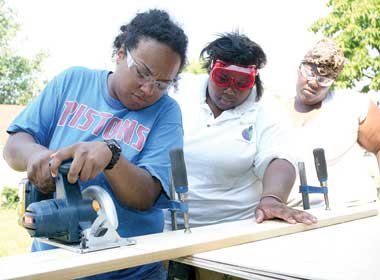

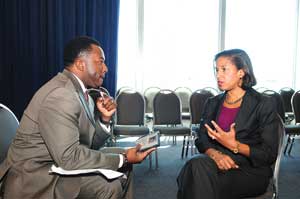
Last week I walked into a gathering of more than 2000 professional Black women called The Links, Inc, at Cobo Hall for a sit down interview with Dr. Susan Rice, the United States Ambassador to the United Nations, and the first African-American woman appointed to that top post.
After I received the call from Rice’s spokesperson, Mark Kornblau, days before her arrival in Detroit stating that he had gotten my name from the White House media department, and was seeking my interest for an interview with his boss, I wondered what message Rice was bringing to Detroit.
Rice is not the labor or treasury secretary to bring a message to Detroit that will resonate with the victims of a tough economic climate. Addressing the economic stimulus package or the high unemployment rate that has become indelible is totally outside of her diplomatic assignments.
But for the top U.S. diplomat stationed at the world’s most recognizable body, the UN, it is within Rice’s purview to talk about how Detroit is a global village and a microcosm of the struggles against inequality around the world.
“The struggle for real equality, both at home and abroad, is one of my life’s greatest passions. The shared belief that all people have equal worth, equal consequence, and yes equal rights lies at the heart of our nation – even as we in this room recognize so well that we have many miles yet to go to make that promise fully manifest, whether at home or around the world,” Rice told delegates to the Links conference. “The Links don’t just work to advance the cause of equality at home. You understand something essential about today’s interconnected world, and that is more and more, all of our fates are bound together, at both the national level and globally.”
Ambassador Rice went on to name what she considers to be today’s threats — rolling out the hot button issues in U.S. foreign policy — such as terrorism, pandemic disease, nuclear proliferation, criminal networks, environmental degradation, genocide, hunger, etc.
So when I sat down with Rice she bolstered the position of President Barack Obama’s administration on the issues she mentioned and its impact in Third World nations in Africa. She talked about the need for young people to obtain a global education that allows them to interact and exchange ideas with people of different cultures as well as familiarize themselves with how the world is rapidly changing.
But that message from Ambassador Rice is a very familiar theme in our own backyard where one school, the Catherine Ferguson Academy for Young Women, is creating a niche in the educational paradigm in Detroit.
In fact, Rice should consider visiting this center of educational excellence that is home to teenage moms who are learning skilled trades to not only fend for themselves and their babies but to also become worthy ambassadors of their communities to the outside world.
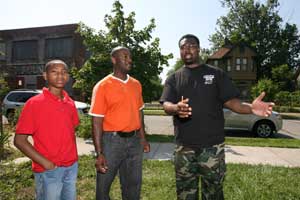

Despite the often youthful mistake of getting pregnant, for instance, at an unprepared age of 15 or 16, these students are being told not to look at themselves as failures but as individuals who can turn their lives around and in turn change the world for the better.
That is why the principal and genius behind the Catherine Ferguson Academy for Young Women, Asenath Andrews, armed with three decades of teaching in the classroom, told me this week that she is creating “global girls,” something that is very evident as six of her students prepare to spend more than two weeks in Soweto, South Africa to take part in the coming Youth Entrepreneurship Conference where they will learn about entrepreneurship, green energy and solar panels, among other things.
In turn, the Detroit delegation will teach their 60 counterpart students from more than four different African nations lessons in urban farming and other agricultural techniques. They will also design and build a community garden and greenhouse in Soweto as part of their community service project.
Soweto is a significant place of pilgrimage for anyone concerned about the state of Black children in today’s complex world and what the future holds for them.
It was in Soweto June 16, 1976 when more than 700 Black South African students were murdered in cold blood in broad daylight during the apartheid era for the audacity to demand a meaningful education.
Since then the world, shamed by what was allowed to happen to Black South Africans under apartheid, has used June 16 as the “Day of the African Child” to commemorate the Soweto massacre.
The Catherine Ferguson students are stepping into history and they deserve it because the school is rapidly becoming a model where the impossible is made possible. Talking to the students you will experience the transformative power of change as Mahatma Ghandi, who once lived in South Africa where he developed some of his ideas, famously said, “Be the change you want to see.”
Going to South Africa, Andrews said, could not have come at a better time.
Why?
Because the students who are leaving July 29 are taking urban gardening to the center of global agriculture at a time when hunger is haunting the world’s poorest and the economically disadvantaged.
Whether it is in Detroit, Soweto in South Africa, Dakar in Senegal or Halifax in Canada, all children are bound by the same need for nutrition and an empowering and quality education.
“Never before have we had the opportunity to travel to another continent. We are really excited about this trip and what it means for the students,” Andrews said. “Now I think they (students) need to begin to think about setting up their own international consulting firm on growing food.”
With international exposure, Andrews said the students are in a better position to build their own businesses in a marketplace where their customers are beyond their own environments.
Tiffiini Baldwin, 18, is ready for the trip. Already she had designed her own business cards. Andrews said the students are all encouraged to have their cards with them.
When I asked Baldwin for her number to invite her and some of her fellow students on my television program to talk about their upcoming trip, she flashed her card and on it was written, “Urban Agriculture Ambassador” with the name, address and location of the school and her contact number.
I was not only impressed but was stunned at how these students are being trained without having the so-called designations of the leading business schools in the nation. Their smartness and wit in understanding the approach to use in asserting themselves in the marketplace is admirable. I did not recall coming across college students who are carrying their own business cards before completing school.
At Catherine Ferguson, the students are taught to create their own industries instead of looking for an industry to work for.
“I am ready to go out and meet new people and learn,” Baldwin said. “I came to the school (in 2008) a little after a month when I gave birth to my daughter.”
Baldwin said the school is enabling her to use urban farming to help in the community.
“It has taught me so much and I’m walking away from this experience with so much,” she said. “I’ve learned life skills, teamwork, how to respond to others in a non-threatening way.”

What is her expectations for South Africa?
“I don’t want to have a lot of expectations. I want to go with an open mind, open heart and learn,” she said.
But she added, “I don’t want to go to South Africa and feel like I’m on vacation,” because she wants to get the most opportunity out of the visit.
Adrienne Minter, 18, who gave birth to a son in 2007 before coming to the school, said her life is much better now.
“Before I was skipping school, but now I’m getting good grades and I’m having a better life,” Minter said.
The thought of going to South Africa, Minter says, thrills her because “I want to help others eat healthy” and traveling to another continent for a course tied to her ambition of being an urban farmer will help do just that.
And when Ciara Hamiel, 18, found out in 2008 that she was pregnant, it was a difficult moment for her as would be any young woman who was not prepared for the consequences of motherhood.
Looking back, she says her life has changed and that a visit to another nation will be a “new outlook on life and to see Africa from our own perspective. It is very fulfilling to learn more about starting my own business and learning about solar energy.”
The innovators of the world today, from Bill Gates and Oprah Winfrey to the founders of Facebook and Google, ventured into entrepreneurship.
Today they are making a permanent and persistent impression in the marketplace.
Detroit City Councilman James Tate said the students are showing another side of Detroit that we often miss.
“They are ambassadors, they are traveling across the world to show another side of Detroit. These students have exhibited resilience and all the qualities of leadership,” said Tate whose “Better Detroit” initiative has a focus on teenage pregnancy and supporting institutions like the Catherine Ferguson Academy.
Against all odds students from struggling backgrounds to now leap forward into the future with promising potential is significant.
“We have kids who have not even ventured on the other side of the city,” Tate said. “Yet these students are getting ready to venture and experience other cultures. But what is exciting about this is that they will come back to the city and help solve our issues.”
The students are presently constructing a greenhouse on a vacant lot on 1554 Temple, where all the materials for the project were donated by Phil Cooley, the owner of Slows Bar-B-Q.
“I think that the students are doing a an amazing thing. I support this educational initiative and wanted to give back to the community,” Cooley said.
Rice, stressing equality and striving together to realize shared hopes and dreams of prosperity, security and liberty in an interwoven world, called for helping forgotten communities.
“Being serious about equality means ensuring that people everywhere — from Harlem to Harare — can rise as far as their talents can take them and not be shackled by the accidental circumstances of their birth,” Rice said.
These students should not pay for the environment they are brought up in or given birth to because they did not create it. But they do take responsibility for their own choices today and are working hard to offer a real and pragmatic alternative to what is beyond the wisdom of sociological experts and self-proclaimed analysts.
Ambassadors do not have to be appointed in gold-written letters. They can be each and every one of us who dare to change and question inequality and address the many ills we are facing.
Catherine Ferguson Academy is playing its role.
What role are you playing?
To support the students with funding for their South Africa trip, call (313) 596-4771.
Watch senior editor Bankole Thompson’s weekly show, “Center Stage,” on WADL TV 38 Saturdays at 1 p.m. This Saturday, July 10, will feature an interview with U.S. Attorney Barbara McQuade about the federal indictments of city officials, including former Detroit mayor Kwame Kilpatrick. A round-table discussion will assess the charges against the ex-mayor as well as the toll the federal indictments are taking on the city of Detroit. E-mail bthompson@michronicle.com