


When the U.S. Supreme Court affirmed affirmative action during the bitter battle at the University of Michigan, the high court of the land submitted to an undeniable truth that “diversity is a compelling interest.”
In 2008, when America stepped out in faith and bestowed the presidency into the hands of a man named Barack Obama, whose father hailed from the East African nation of Kenya, the world watched in shock and awe at this compelling display of diversity. That at some point people of goodwill and faith can look beyond one’s skin color and cultural and ethnic background and appreciate the intellect, honesty and competence of a person.
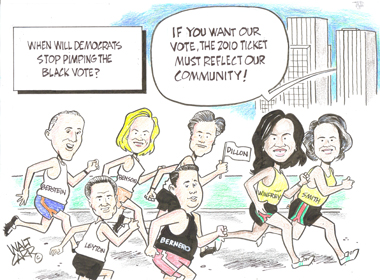
In 2010, in the age of Obama, the party that delivered such a presidency is now been asked in Michigan to make diversity a compelling interest in this year’s election season. It should not come as a shock that an African American or person of any other ethnicity should be thrust to the higher levels of state government. Therefore the Michigan Democratic Party, this all encompassing political institution that brands itself as the party of the disenfranchised, should live to its creed of diversity. It makes sense, like Howard Dean once said at a Democratic leadership summit in downtown Detroit, that those who come asking for votes in communities of color should be held accountable if their ticket is not diverse.
This request should not even be up for discussion because the Democratic Party has succeeded in painting Republicans as the political group that is an anathema to diversity and its accompanying attributes. Whether that is true or not, the party that boasts of allowing everyone to have a seat at the table of equity despite their status in society should take the lead in making that claim a reality.
Democratic Party bosses should not have to be reminded to live up to the historical obligation the party has been committed to. The party that championed the 1964 Civil Rights Act cannot now abandon its moral and historical obligation to addressing the needs of people of color. If African Americans are good enough to show up in mass numbers at the polls and gladly catapult candidates running on the Democratic Party ticket to an array of offices, they must equally be good enough to be on the ticket.
There should be no hesitation about choosing a candidate of color. There are African Americans who are thoroughly qualified to be on any of the tickets this year. But the excuse some party officials would like to give is that they can’t find any competent Black candidate who is electable. That is cynically playing reverse racism and strengthening the notion in 2010 that a Black candidate cannot win in Michigan, giving affirmation to prejudice.
Well that kind of excuse is a suspicious refrain that has always been the crutch that the party walks on when taking the Detroit vote for granted. Just as party bigwigs tirelessly work behind the scenes in search of good candidates and even offering all kinds of incentives to pull in so-called individuals with sterling qualities to run, why can’t it do the same for an African American candidacy?
If the party is willing to bring all of its resources and connections to bear when White candidates are the focus, it should do the same for candidates (African Americans and other communities of color) who, in fact, form the base of the party.
I can hear some party officials who want to mask their reluctance into perpetual denial say we don’t understand how the process works because candidates have to raise money on their own. Therefore, an African-American candidate is less likely to be able to raise money.
Really?
Yeah, right. We all know for certain that such an explanation will not even pass the laugh test because it is fraught from the premise.
Candidates do have to raise money on their own, but when the party openly declares and embraces a particular candidate without hesitation about their electability, it goes to work to ensure that candidate wins. It leverages its political clout to get the purse strings open so that candidate can crisscross the state and make his/her case to voters.
So what is the excuse of the Michigan Democratic Party and the high priests who call the shots?
This Saturday, April 17, at Cobo Hall, the Democratic Party will hold its Endorsement Convention to declare support for the candidates for attorney general and secretary of state.
This endorsement convention is coming with heightened interest among many in Detroit who are watching closely to see if the lone African American running for secretary of state, Janice Winfrey, Detroit City Clerk, will get the nomination instead of Wayne State University law professor Jocelyn Benson.
Both Winfrey and Benson are qualified even though Benson has raised more money than Winfrey.
So unless the party proves me wrong, Benson will be the Democratic Party nominee for secretary of state on Saturday.
It is important to note that the onus is not on Benson to prove that she is committed to diversity because her supporters say her track record of working in civil and voting rights speaks for itself. The burden of proof is on the party, not her.
Winfrey’s supporters rightly believe she should get the nomination because of her experience manning the largest election department in the state.
But unfortunately, the Benson candidacy stands to be a victim of the Democratic Party’s unwillingness to accept diversity within its inner ranks. Her candidacy could potentially be seen as a pun on the chessboard of Democratic Party politics and as a result be misconstrued to some. She could be viewed as a member of the party cabal and the favorite of the chief priests who gather in the political temple to decide who moves to what position.
Benson should not allow this perception to prevail because it will squander all the work she did campaigning for secretary of state.

On the question of the attorney general candidates, there is not much room left to discuss the possibility of a candidate of color. Not since the candidacy of Amos Williams, the African-American Vietnam War veteran and lawyer who was left to the political knackers after the party did little or nothing to help him raise money to fight Attorney General Mike Cox.
Richard Bernstein and David Leyton are duking it out for attorney general and Bernstein, who hails from an influential legal family, will most likely get the nomination.
After this Saturday’s political kumbaya gathering at Cobo, the party will come together for another “all hail the king” event in August when it nominates the candidate for governor to challenge the Republican nominee.
Presently, House Speaker Andy Dillon, Lansing Mayor Virg Bernero and State Representative Alma Wheeler Smith are in the run for governor.
Smith has no chance of being the nominee even though she, like all the other candidates, has significant legislative experience. But some believe that she is not electable. However, that depends on who you talk to and what her state outreach has been.
There is an outcry for an African American on the gubernatorial ticket as lieutenant go
vernor. Michigan has never had an African-American lieutenant governor and the party of “diversity” is being challenged now to make that a reality.
If Detroit, which votes 90 percent Democratic, the largest Democratic constituency in the state, is that significant to the foundation of the party’s existence, there should be no pause for a candidate of color on the gubernatorial ticket as second-in-command.
Democrats should show that they are bigger than the Tea Party movement and do what is required of them to present a diverse ticket and send a message to those who want to shift — all the way back to the 1950s.
An all-White ticket on a party platform that sings the mantra of diverse communities is an affront to those very communities who work tirelessly to get the votes for the party. It shows something deeper that perhaps we are yet to explore.
Does the party, in fact, believe in an inherent diverse political message that resonates with the communities that make up the very essence of the party?
Does the party believe in the distinctive attributes of various political voices?
Does the party believe in the eminence of democratic multiplicity?
Or does this party want to continue an oligarcy system where the minority rules at the expense of the majority?
Democrats, in the words of Dr. Martin Luther King Jr., have an opportunity this year to “make real the promises of democracy” and offer a strong diverse ticket that can win.
This move does not require a surgical operation for it to happen. And those Black elected officials who are always happy to be paraded by the party to serve as a buffer to any demands for diversity owe Detroit better representation and advocacy this time around.
Too often in a rush to vindicate itself from its sins and transgressions against Black voters, the Democratic Party applys the laughable but cunningly disturbing method of dispatching certain Black elected officials as ambassadors to plead their indefensible case before Detroit constituents.
These elected officials, without bargaining anything substantial for Detroit or any other communities of color within the party, readily and gladly come in droves to the community in an apparent attempt to save the legacy of the party. Of course, their refrain of the party that salvaged civil rights, votings rights and every other justice oriented democratic proposal always hypnotizes those who would dare raise Socratic irony about the party’s commitment to diversity. Worst of all, such a carefully orchestrated campaign of doing the master’s bidding only serves to handicap the current demand for diversity.
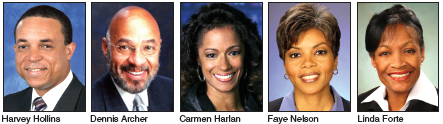
Several African Americans have been mentioned for lieutenant governor should the party wake up from its slumber and realize that it is overdue. Following are some of the names been mentioned:
Dennis Archer, former Detroit mayor, brings a wealth of political as well as legal background to that role. Archer is the first Black to head the 400,000-member American Bar Association.
Harvey Hollins, Wayne State University vice president of Government Affairs, who served in a top managerial capacity with the state’s AARP, will bring a résumé of education to the ticket.
Freman Hendrix, chair of the Detroit City Charter Commission and former deputy mayor, knows Detroit politics inside out and is now at the helm of an institution that would guide this city’s future for many years to come.
Faye Nelson, CEO of the Detroit Riverfront Conservancy, is a development czar with a background that stretches to Wayne State University and other entities and is on the board of a major corporation (Compuware). She brings an impressive mix to the ticket.
Jeffery Collins, who formerly served as a judge before managing the Eastern District as a presidential appointee, has an interesting record that would have people watching closely.
Reginald Turner, State Board of Education member who heads Detroit’s Board of Ethics, brings a political and legal framework to the ticket.
Linda Forte, senior vice president at Comerica Bank, brings an extensive business and community development experience.
Carmen Harlan, WDIV anchor and a fixture in Detroit television for decades, comes with a stellar and practical experience in media coverage of the people’s business at a time when media is now entering government with more frequency, such as newly-elected Detroit City Council President Charles Pugh.
If all these individuals can pass the vetting process, they should be considered.
Diversity happens when Detroit demands it, not when elected officials are going around in an opium-fashion tour to cool off constituents with historical narratives of what the party did in the past while their present condition remains dismal.
Watch senior editor Bankole Thompson’s weekly show, “Center Stage,” on WADL TV 38 at 1 p.m. This Saturday’s program, April 17, will feature an in-depth exclusive interview with Michigan Lieutenant Governor John Cherry focusing on why he dropped out of the race, his assessment of the Granholm administration, the state of the Democratic Party and the current gubernatorial campaign. Bankole Thompson, whose coverage of the historic 2008 presidential campaign included a series of sit-down interviews with candidate Barack Obama, is the author of the forthcoming book on President Obama and Black America. E-mail bthompson@michronicle.com.