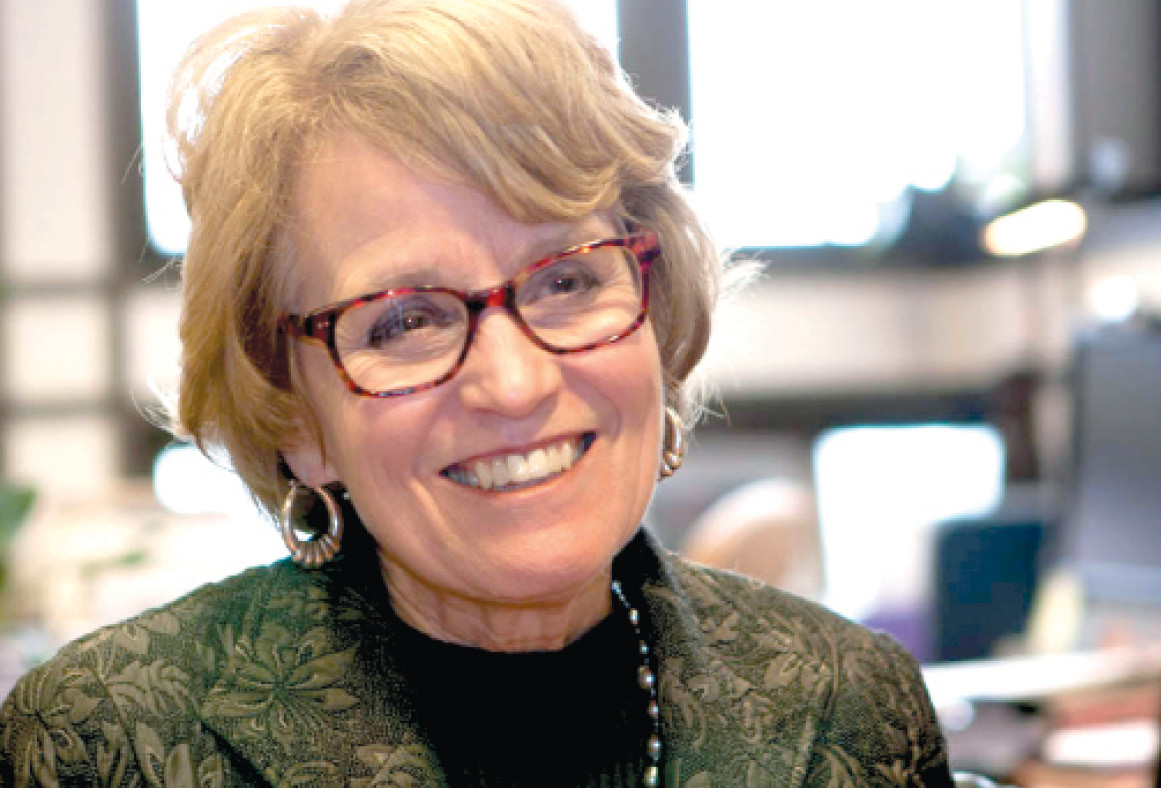
MARY SUE COLEMAN, 13th president of Michigan’s largest educational institution, the University of Michigan, will bow from the public stage in July after 12 years. Brown University Provost Mark Schlissel is the incoming president. In the coming months the Chronicle editor will do incisive analyses on expectations of the new president with emphasis on diversity.— Andre Smith photos
For more than a decade, 12 years to be exact, Mary Sue Coleman, sat at the helm of the University of Michigan as its 13th president and the first female in that role. During that period, Coleman, 70, sat down a number of times with Michigan Chronicle editor Bankole Thompson to discuss a wide range of issues, from affirmative action to the university’s engagement with Detroit, among other topics. At one point Coleman appeared for a special town hall style conversation in Detroit at the Charles H. Wright Museum of African American History with education leaders on “Beyond Affirmative Action: Challenges of an Empowering Education,” moderated by Thompson.
As Colman prepares to make the final bow out of office in July when Brown University Provost Mark Schlissel will take his seat as the 14th president of UM, she sat down again with Thompson for an exit interview. Excerpts.
MICHIGAN CHRONICLE: What is life going to be like after 12 years at the helm of the University of Michigan?
MARY SUE COLEMAN: I think it’s going to be pretty interesting to be able to control my time a little bit better. I have been very careful about not loading up too quickly. But I’m looking forward to it. Ann Arbor will be our home base but we have a place in Colorado where our grandchildren are.
MC: What was the decision that led to your retirement?
MSC: Well, I’ve been a university president for 19 years, seven at the University of Iowa and 12 here. My husband has been enormously patient all these years. We just want some time off and I really have some things at the national level that I want to concentrate on.
MC: So you still will be engaged?
MSC: Oh sure. I’m doing this big project in the American Academy of Arts and Sciences on the value and position of public research universities for the nation. That will take a lot of my time. And I’m going to be on some foundation boards and maybe write some things, issues related to higher education that are important to me.
MC: Will you write a book?
MSC: I don’t know about a book. We’ll see, but anything is possible. I think that’s the value of retirement.
MC: What are the three things you’ve been able to accomplish in the last 12 years?
MSC: I think our opportunity to be able to purchase the old Pfizer site — the north campus research complex. It was a transformative opportunity. I was so pleased and the board really supported it. Within the last four, five years we’ve been able to take that number of people there as many as Pfizer had. So it’s been good for the community. Also the things we’ve done on residential life initiatives. They hadn’t been upgraded to what students need. So we are really making progress in those areas. Also the whole focus on helping the state with entrepreneurship, trying to give more opportunity for our faculty and students to create companies. But also to make sure we are connecting more with the needs of the state and the community. But there have been many other wonderful things.
MC: What do you think of the governor’s announcement of increasing state funding for public universities?
MSC: I think it is a very positive sign and also there has been lot of good work by the Business Leaders of Michigan who saw that we had to do this to be a top ten state to attract jobs. So I feel very optimistic about it.
MC: Where do you place the university in the economic equation of the last 12 years?
MSC: We’ve created this alliance between the three research universities (University of Michigan, Michigan State University and Wayne State University). We talk and walk together all the time, and we do economic impact reports every year and the differential impact the three universities make not only in their local economy but the state economy. I hope doing that regularly we’ve been able to show people how valuable it is. It is not only to provide opportunity for students and faculty, but to create an environment people would want to come to and want to stay in the state.
MC: What imprint did you have at the back of your mind when you first came to run the University of Michigan?
MSC: The reason I was attracted to Michigan is because I always thought that the University of Michigan was a place that everything important happens in higher education. From the whole affirmative action debate and the fact the university stood up and defended it, the Google project, I thought this is a place where the university takes risks and stands up.
MC: What is it exactly that you wanted to change?
MSC: I certainly wanted to do two things. One was to really create an entrepreneurial culture, and we had to change a lot of things to make that happen. The second thing was the collaboration across colleges.
MC: As you plan to leave office, what is your reflection on the struggle of affirmative action?
MSC: For me it was the one thing that attracted me here. Win or lose I wanted to be part of it. It was worth the fight. So I was so thrilled when basically the Supreme Court affirmed the value of affirmative action. It was very disappointed when the citizens of the state changed the Constitution. But at the end of the day the value of affirmative action was affirmed in the Supreme Court and for me that is a lasting value.
MC: Let’s talk about the recent Black students protest for diversity on campus. Is this a challenge or an opportunity?
MSC: Well this has been sort of a concern. We’ve been working very hard ever since Proposal 2 (affirmative action) was changed. We started out with diversity blueprints and trying to think about every single part of the campus because we knew there is no silver bullet here, this isn’t something that’s going to be easy. On the one hand I certainly understand what the students are saying and I certainly share their frustration. But again I think that what their stories do is give us renewed energy to say “OK, we have to find other ways.” It will be a continuing issue for us and so I am perfectly willing, and I know that my successor is very willing, to continue to see what we can do to change. We’ve had some pockets of pretty good success. Interestingly enough, we are having little bit more success in the graduate school than in undergraduate. We’ve had some places in engineering where they’ve created some strategy that seemed to be bearing fruit. So we’ve got to learn from each other.
MC: What is your legacy?
MSC: I have to leave that to others. I don’t know what people will say.
MC: What is there about you that people don’t know?
MSC: I don’t know. The only thing I can say is I just love being here. I love this job. I love getting to know Michigan because I didn’t know Michigan when I came. It is a beautiful state. There are so many opportunities here. Even with all the struggles in Detroit and the issues related to bankruptcy, there is a spirit about it that is very engaging.
MC: What about the university’s engagement with Detroit?
MSC: We’ve learned a lot (with the office on Woodward) about the ways in which we can be engaged and the programs we have for young people in high school. By having the office we’ve gotten more of our faculty and different colleges to think about engagement. One of the other ways I see is the ways in which young people are attracted to Detroit. And many of them want to stay afterwards because they can see this is an opportunity to help with the city. It is not same in Chicago, New York, Milwaukee and Cleveland. This is a different opportunity and our encouragement of students to do that is very important. We had hundreds of interns there last summer.
MC: If the goal is to encourage more Black students to enroll in the university, will you look at creating a lab in Detroit?
MSC: What we have done so far is to try to partner with the schools there. It is a big thing to set up a lab. The Detroit Public Schools has an infrastructure capacity that is good. Our goal is to make partnerships wherever we can with willing schools to have students come here for the summer. I really worry about the notion that we’ve got all the answers.
MC: You’ve had an accomplished life. Who’s had the most influence on you?
MSC: I’ve had a lot of mentors in my life, including my parents and people who took great interest in me and pointed me in the right direction. I never planned to be a university president. But opportunities presented themselves and doors were opened.
MC: How important was it for you to become the first woman president of the University of Michigan?
MSC: Well, I was also the first woman president of the University of Iowa. This is what we want for our society. It is a good thing (laughs). I would like for all university presidents to come from all (backgrounds, so this is an opportunity for everybody.
MC: Was it your influence that brought Brown University provost Mark Schlissel here as the incoming president because both of you are scientists?
MSC: I don’t know. I was not a part of the search. This is the job of the regents. It is interesting that he is actually the same kind of scientist that I am. I don’t know what they were looking for (laughs)….who knows. I think people from a lot of backgrounds can be a university president. But I think scientific backgrounds can be helpful too.
MC: What do you expect from him?
MSC: I don’t know what direction he will take the university. Obviously, whenever you come into a university there is always unfinished business. I’m hoping that I’m leaving the university in good shape so that the next president really does have a good platform to put his ideas. I’m sure he will come up with wonderful ideas about the direction of the university.
MC: What should he look for?
MSC: You know he is a smart guy and he’s been in a lot of good places.
MC: He’s going to have to deal with the issue of diversity that the Black student union is raising, just as you came in during the affirmative action fight.
MSC: He will. I think the fact that he was at U.C. Berkeley for a number of years because Berkeley has some of the same restraints that we have now. I know that he has thought about that. And he may have some new ideas. I think it is good to have his perspective on this matter.
MC: Have you had any big decision that you’ve made that has challenged your presidency without the consultation of your staff?
MSC: Oh sure, but I can’t share. There is always a moment of truth. (Laughs).
MC: Any regrets?
MSC: Here is what makes me sad sometimes but I think I worked hard and certainly tried, and that is this climate issue (Black student union protests). I don’t want any student at the University of Michigan to feel unwelcomed. I wish I could have made that better. It’s a worthy goal but I know the university will carry on to make it better.
MC: The challenge for incoming president Schlissel?
MSC: There will be plenty. It comes with the job.
According to the University Record, under President Coleman’s tenure, the university did the following:
Budget Growth- 69.9%
Growth in Endowment- 140.6 %
Philanthropy – 1,281,076 donors
Cash Gifts & Pledge Payments – $2.9 billion
Largest Gift (Stephen M. Ross) $200 million
Research Spending Increase – 77.2%
Financial Aid Increase – 86.9%
Increased Enrollment for all Three Campuses – 15.9 %, 40.1%, 3.2%
Invention Reports – 3,503
Faculty Startups -107
New Degree Programs – 49
Degrees Conferred – 157,217
Increase in Tenure Track Faculty -13.7%
Faculty Elected to National Academies – 90
Books Scanned by Google- 4,674,528
Patent Applications-1,518
New Buildings & Major Additions – 55
UM Health System- 18 million clinic visits, 41,000 births, 865,000 emergency visits
Trees planted -2,316 and 24 public art installations
Bankole Thompson is the editor of the Michigan Chronicle and author of the forthcoming 2014 book on Detroit titled “Rising From the Ashes: Engaging Detroit’s Future with Courage.” His most recent book, “Obama and Christian Loyalty,” deals with the politics of the religious right, Black theology and the president’s faith posture across a myriad of issues with an epilogue written by former White House spokesman Robert S. Weiner. He is a senior political analyst at WDET-101.9FM (Detroit Public Radio) and a member of the weekly “Obama Watch” Sunday roundtable on WLIB-1190AM New York. Email bthompson@michronicle.com or visit www.bankolethompson.com.
About Post Author
