


With the passage of the historic health care legislation, coverage for the uninsured is now at the center of the national conversation around health care as the new law that, among other benefits, will prohibit denying insurance to patients with preexisting conditions.
Covering the uninsured and low-income earners has been the hallmark of the Detroit Medical Center for decades.
And now as DMC prepares to be under the new ownership of the Vanguard Health Systems, moving from a nonprofit to for-profit status, DMC officials say the health system will continue providing medical care to the underserved — a role that has long distinguished the DMC from every other health system in the state — in Detroit.
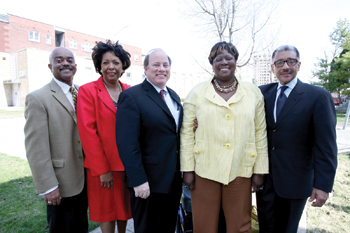
DMC President/CEO Mike Duggan, accompanied by four of the health system’s top executives, including Dr. Iris Taylor, president of Detroit Receiving Hospital; Dr. Herman Gray, president of Children’s Hospital; Conrad Mallett, president of Sinai Grace Hospital; and Cassandra Smith Gray, corporate executive director of Community Affairs for DMC, visited the offices of the Michigan Chronicle on April 1 for an editorial meeting.
All five executives said the reason for the immediate transfer of ownership to the Vanguard is to get the best deal for DMC while it still remained a profitable institution.
“We are the hospital system that treats everybody regardless of their ability to pay. That’s who we are and that’s really our core. The reason we are doing this deal is we think it’s a whole lot more likely that DMC will be around for future generations,” Duggan said.
For the last six years, according to Duggan, DMC has remained profitable — in the black — unusual in such a dire economy which triggered some of its board members, such as Roger Penske, to explore the idea of getting investors.
“When you are a nonprofit that means you have no investors. You have no one to turn to when things are going badly,” Duggan explained. “The only way you can get money for the latest equipment or modern facility is you go to Wall Street and borrow it.”
Going to Wall Street, Duggan said, would mean having to repay those loans in 20 years.
“We think Detroit is going to lose population, remain poor and therefore we can’t borrow any money at all to modernize,” Duggan said.
However, he said the irony is that some of the suburban health systems that have lost money have not had any trouble borrowing huge amounts of money which in itself has affected Detroit.
“The nonprofit model has been a disaster for the city of Detroit in health care. You’ve seen all of these nonprofits either close their hospitals or moved into the suburbs,” Duggan said.
“And it is not because the managers of these hospitals are bad people. Its that if you have to go to Wall Street to borrow, you are borrowing for investment in a community Wall Street doesn’t think has a 20-year good horizon.”
The DMC chief cited as an example Northwest Oakwood Hospital, which he said two years ago was going to shut its doors until the hospital doctors came together and decided to become investors to keep the hospital open.
That is a sign of the times for Duggan who insisted DMC has to be ahead of the curve and not have to wait until its in dire straits to look for investors.
Vanguard Health Systems, known as an urban based hospital system that operates in five states, is currently the eighth largest investor-owned hospital system in the country. The purchase of DMC will make the health conglomerate the fifth largest.
According to the Vanguard/DMC agreement, the operations in Michigan will be overseen by a board comprised of four members appointed by Vanguard and three members from DMC.
DMC will continue to operate under its legacy names and the current management team of hospital presidents and its CEO, Duggan, will remain in place.
In the next five years Vanguard agrees by contract to infuse $850 million into DMC, making it the largest private investment in Detroit’s history. Of that amount $500 million will go toward major capital projects and $350 million will be used for routine capital and equipment.
Duggan said also DMC’s board was able to get Vanguard to put $500 million of its own stock in escrow.
Their failure to fulfill their part of the agreement would mean DMC’s board, which exists as a separate entity, will take Vanguard stock.
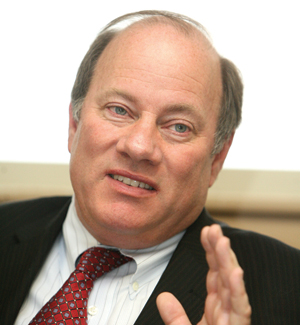

“So it’s not some promise you’re not going to know whether they are going to make or not,” Duggan said. “They’ve got $500 million and if they fall behind $20 million in the first year, the DMC board takes the whole $500 million in Vanguard stock.”
At the heart of the deal Vanguard has made four significant commitments that serve as the pillar of DMC’s operations.
1. Keep all DMC hospitals open for the minimum of 10 years.
2. Keep DMC’s charity care policy for a minimum of 10 years (covering the uninsured).
3. Fully support the Wayne State University partnership and DMC’s education mission.
4. Keep DMC as a Detroit-based hospital system. Duggan said DMC must have first class hospitals to compete with other health systems that may be looking to invest in the city.
Sinai Grace Hospital president Conrad Mallett said with the infusion of capital, 40 percent of the people who leave the city of Detroit in search of better care elsewhere will now hesitate.
“They will slow their cart down just a little bit, will consider Children’s Hospital, the world class institution in their own backyard first,” Mallett said. “And I will have a better chance at Sinai Grace competing with Beaumont Hospital. The mission has not changed.”
Several groups have planned to challenge before the Detroit City Council the transfer of ownership to Vanguard, questioning the legality of DMC’s board to do so. Some of those critics are expressing fear that the promises and agreements may not hold true.
But Mallett said DMC will not be distracted by that as it continues its mission of serving everybody regardless of their financial status because the arguments over legality of the sale will be left to lawyers to do.
“Forget the legal document. What is the moral and ethical responsibility the DMC has to the people of the city of Detroit and how best they carry that out? And the way we best carry that out is to do everything to flourish collectively so that Detroit Receiving Hospital can be the hospital everybody envisions it to be,” Mallett said.
Sinai Grace’s emergency department will be expanded to treat the increasing number of trauma cases and accommodate new medical technology as well as provide students and residents a better educational and training centers.
Dr. Iris Taylor, who heads Detroit Receiving Hospital (DRH), said she supports the new change for DMC because “the citizens of Detroit deserve to have first class health care and we provide that. We deserve to have that in a first class facility and this is what the Vanguard acquisition will provide for us.”
Taylor said aside from the massive upgrades DMC hospitals will u
ndergo, it is also a “huge infusion into the city of Detroit. Construction jobs, infusion for small minority firms that we have a commitment to use in this project. So the community as a whole where the density is changing and there is no economic improvement, there is an opportunity to flourish.”
DRH, the only hospital in the area approved by the federal government to treat government dignitaries, including the president, is set for a makeover with two new state-of-the-art operating rooms and also increasing space in its pre- and post-operative unit
Dr. Herman Gray, Children’s Hospital of Michigan president, equally applauds the deal.
“This will elevate a very good children’s hospital, nationally known. Detroiters can be assured that they would have the best pediatric care in one of the best facilities in the country,” Gray said.
The hospital was built in 1971 with a capacity to hospitalize 600 patients a month, but today the hospital sees more than a 1000 kids and conducts more than 1200 monthly surgeries, and its clinics now handle approximately 16,000 children in a month.
This new development for facility transformation and upgrade “is what our kids deserve,” said Gray.
Harper Hospital, built in 1975, will expand its surgical operating rooms and add cutting edge technology.
The main floors and corridors of the Hutzel Women’s Hospital and the Cardiovascular Institute will be renovated for patients and visitors to find their way to clinical services throughout both hospitals.
That means four patient floors and patient rooms will be brought to current standards for private and semi-private care. The restrooms will now be made handicap accessible.
For nurses and physicians, there will be expanded work areas and the hospital heating and cooling system will be upgraded to meet the comfort of its patients.
Wayne County Commission voted to approve the Wayne County Renaissance Zone for a central campus for DMC in accordance with the sale.
DMC’s main campus does not have adequate parking for visitors and staff, so the parking deck on Mack will be demolished to open up the southern end of the downtown campus. Also a new parking deck with 1,750 parking spaces will be erected next to the new Cardiovascular Institute.
Now DMC has to appear before the City Council.
Duggan said he and DMC board members met with hospital buyers from around the country in securing this deal.
“Most of the for-profits would like to buy in Birmingham and Bloomfield in making a profit margin,” Duggan said. “But when we got to Nashville (Vanguard headquarters) and met the Vanguard group, this was fascinating. These guys have chosen exactly the opposite strategy.
“They looked at all of the cities in the country where the nonprofits are bailing out and they said, ‘What if instead of chasing the patients to the suburbs the way everybody else is doing, what would happen if we went into the urban areas, build first class hospitals?’”
Vanguard, he said, believes that it can make money in urban areas by attracting everyone to the improved facilities.
Watch senior editor Bankole Thompson’s weekly show, “Center Stage,” on WADL TV 38, Saturdays at 1 p.m. This Saturday’s program, April 10 will include a discussion with the Federal Reserve Bank of Chicago -Detroit Branch as well as a roundtable conversation about fatherlessness in metro Detroit. Robin Wright King of the Detroit Fathers and Families Coalition and Roger McPhail from the city of Detroit Fatherhood Program will talk about an upcoming April 22-23 conference on fatherhood at the Samaritan Center on Detroit’s eastside. Bankole Thompson whose coverage of the historic 2008 presidential campaign included a series of sit-down interviews with candidate Barack Obama, is the author of the forthcoming book on President Obama and Black America. E-mail him at bthompson@michronicle.com