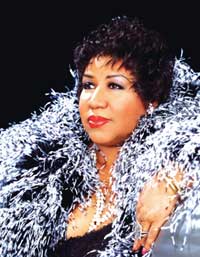
ARETHA FRANKLIN is recognized all over the world — and maybe in other galaxies — as the Queen of Soul. Classics like “Respect,” “(You Make Me Feel Like) A Natural Woman” and “Think” are etched in gold on the international music landscape.
Diana Ross is the ultimate glamorous star. No other lady of song even comes close. (One year she hosted the American Music Awards and changed clothes during every commercial break!)
She was born to be what she is. Failure in show business was not an option. It was a matter of “when,” not “if.”
The music has been good, too, including “Reach Out and Touch (Somebody’s Hand),” “Love Hangover,” “Touch Me in the Morning” and “Upside Down.”
Anita Baker is also special. So are Freda Payne, Kem, Ortheia Barnes, the Spinners, Jo Thompson, the Detroit Emeralds, Little Willie John, Kimmie Horne, the Jones Girls and Dwele.
Also, Lonette McKee, Cherrelle, the Dramatics, Bettye LaVette, Eminem, Jackie Wilson, Aaliyah, Thornetta Davis, Michael Henderson, Laura Lee, Ray Parker Jr., and on it goes.
We can’t name them all.
DETROIT IS often referred as the Gospel Music Capital of World, thanks to a bevy of outstanding artists, among them the Winans, the Clark Sisters, Fred Hammond, Vickie Winans, J Moss, CeCe Winans, Kierra “Keke” Sheard, Commissioned, BeBe Winans, Vanessa Bell Armstrong, Thomas Whitfield, Eddie Robinson and more.
Detroit is also a powerful force in rock. The high-energy, hard-hitting kind, as exemplified by Mitch Ryder, Iggy Pop, Kid Rock (although we’re still annoyed with him for telling “Dateline NBC” that Detroit has become “a ghost town”), the White Stripes, the MC5, Bob Seger and others.
There is a reason Kiss recorded “Detroit Rock City” and Huey Lewis & the News identified Detroit as part of “the heart of rock and roll.”
Detroit has also made extraordinary contributions in the jazz realm. Actually, a book could be written on that subject, the artists ranging from everyone from Kenny Burrell, Yusef Lateef, James Carter, Milt Jackson, Spencer Barefield and Wendell Harrison to Geri Allen, Straight Ahead, Earl Klugh, Harvey Thompson, Marcus Belgrave, Harold McKinney, Regina Carter and Dorot
hy Ashby.
And let us not forget that Detroit is where George Clinton created one of the most enduring and influential forms of Black music — P-Funk. The term is, of course, “shorthand” for Clinton’s two powerhouse groups, Parliament and Funkadelic. (Essentially the same people.)
Those awesome hits — such as “One Nation Under a Groove” and “(Not Just) Knee Deep” — will always be exciting and relevant.
We have covered a substantial amount of territory, but there is so much more to the Detroit music story. Just as there is so much more to the story of the city itself.
There are a lot of good things here, including the incredible riverfront with easy access to another country, the beautiful Fisher Theater that surpasses just about any theatre in New York, splendid stadiums, Belle Isle, fine restaurants, Orchestra Hall, Greektown, the culturally rich Southwest Detroit, the “Hair Wars” fashion extravaganzas, diverse places of worship, Campus Martius, and so much more, including people with a heart.
The image can be changed, or at least altered. I recall riding in a cab in Florida during the time Dennis Archer was mayor and there was optimism in the air.
Upon learning that I was from Detroit, the cab driver didn’t do any bad-mouthing. He just said, “I hear Detroit is making a comeback.”
That felt good.
About Post Author
