


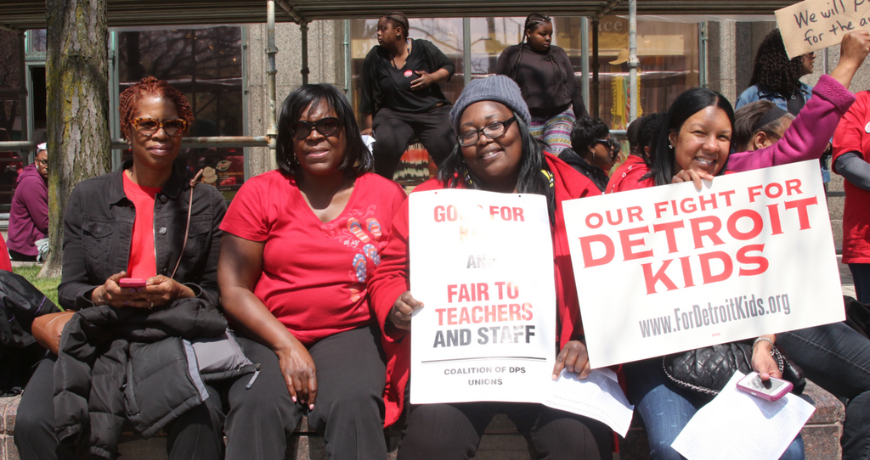
In a critical moment for Detroit Public Schools Community District (DPSCD) and its primary teachers’ union, a tentative agreement was reached just hours before the expiration of a previous contract. The new contract proposes a six percent increase in salary for teachers at the top of the pay scale, potentially raising their base salary to around $74,000 for the coming academic year. Meanwhile, teachers at the lower end would only move up one step, amounting to an approximate 2.4 percent salary increase. The final vote was Friday, Aug. 25, at noon, with 1,121 “yes” votes and 406 “no” votes, making the one-year contract ratified with 73.4 percent approval.
“We are excited. This is the largest increase since 1989 that the Detroit Federation of Teachers has experienced,” said Detroit Federation of Teachers President Lakia Wilson-Lumpkins. “We are glad that we are making strides to make up the loss during emergency management, and we are taking steps in the right direction.”
The instated six percent salary hike significantly benefits those at the top of the pay scale, but does little for those who are at the beginning or mid-point of their teaching careers. This raises questions about how effectively the new contract addresses systemic inequalities within the profession.
“We knew that it would be a bold stance, but we knew that change would not come to surface if we did not stand in solidarity with one another,” said Janet Wilkens, former Detroit educator that was in the midst of the 1999 Detroit teachers strike. “Yes, it was intentional to charge this just days before the start of the school year. Why? Well, because people listen when drastic measures are taken.”
The issue of teacher salaries in Detroit has been a long-standing concern. Once upon a time, Detroit’s teachers were among the highest-paid in the nation. However, the financial crisis that led the city into bankruptcy, and years under emergency financial management, took a toll on educational funding. Teachers faced wage freezes, crowded classrooms, and deteriorating school conditions, with some even resorting to public protests and sick-outs to draw attention to their plight.
In Detroit, where most students are Black, the representation of Black teachers is also of concern. It’s not just a matter of diversity, but a need for role models who understand the cultural and social challenges that students face. Research shows that Black students are more likely to succeed academically when taught by Black teachers. However, financial disincentives could dissuade potential educators from serving in a district that requires so much yet, historically, has offered comparatively less than surrounding districts in compensation.
To make matters more complex, the district has had to make tough financial decisions, including consolidating approximately 300 positions to finalize a $1.138 billion budget for the new school year. These cuts affect various roles within the system, including essential roles like school culture facilitators and kindergarten paraprofessionals, positions often pivotal in shaping a positive educational environment.
The history of teachers strikes in the United States and particularly in Detroit underscores an ongoing struggle for improved labor conditions, fair wages, and equitable educational opportunities. Nationally, one of the most notable teacher strikes occurred in 1968 in New York City, where a dispute over community control and racial issues led to a series of strikes that lasted for 36 school days.
In recent years, significant strikes in states including West Virginia, Oklahoma, and Arizona have attracted national attention, advocating for higher pay and better resources. These actions followed a trend of stagnant or even decreased public education funding, with the National Center for Education Statistics reporting that the average inflation-adjusted salary for public school teachers decreased by about 1.3 percent from the 1999–2000 to the 2018–2019 school years.
In Detroit, teachers have also resorted to labor action as a means of protest. In 1999, Detroit’s teachers went on strike for nine days, affecting 172,000 students. They were demanding better pay, smaller class sizes, and improved safety measures in schools. More recently, in 2016, Detroit teachers organized a series of sick-outs, where teachers orchestrated a collaborated effort to all call into work sick. It caused the closure of more than 90 public schools throughout the city. The sick-outs were not technically strikes but served as a protest against poor working conditions, including overcrowded classrooms and inadequate, sometimes even hazardous, school facilities. These actions came after years of emergency financial management and state-led oversight, during which time the Detroit Public Schools debt rose to over $3.5 billion by 2016, according to a report by Citizens Research Council of Michigan.
“I was 49 years old in 1999, I am now retired and well-seasoned,” Wilkens said. “I commend the teachers of today especially and most importantly our Black educators, our babies need that, but it is important to understand that teachers need a salary that supports their babies and their livelihoods. Are they really asking for too much? Absolutely not.”
Both nationally and specifically in Detroit, teachers strikes and protests serve as a collective, often last-resort action aimed at highlighting systemic challenges that have long-term implications for educators and the students they serve.
One silver lining is that due to recent legislation, teachers have regained collective-bargaining rights on several vital issues, such as performance evaluations and teacher placements. This could bode well for future negotiations and greater advocacy for equitable treatment within the profession.
Key Points of Detroit’s 2023-24 Teacher Contract:
- Union members at the highest tier of the pay scale are slated for a 6% salary boost in the 2023-24 academic year. With this change, those holding a bachelor’s degree could see their base salary climb to $73,922, while those with a master’s degree could make as much as $86,000.
- Academic intervention specialists are also targeted for a 6% salary increase, raising their annual income from $40,456 to $42,883.
- Teachers not at the highest tier would progress one level up the salary ladder, translating to an average pay increase of about 2.4%, barring those moving to the highest tier.
- Retired educators who rejoin the district would be positioned at the top of their respective pay scales, contingent upon verification of their professional experience. They would be entitled to the same bonuses and benefits as their currently serving counterparts.
- Special education teachers in particularly challenging-to-staff specializations could receive a bonus of $15,000.
- Educators who have dedicated 15 years or more to the district are in line for a one-off $4,500 longevity bonus. Similarly, union members who have served as long but aren’t on the teacher salary schedule would get a $2,000 bonus.
- Professionals like nurses, therapists, social workers, and counselors affiliated with the union are also set to receive a $2,000 bonus.
- Retention Bonus $2000.00 for all full-time members, $1000.00 Retention Bonus for all part-time members
- Union-affiliated substitutes are not left out: long-term substitutes are earmarked for a $2,000 retention bonus, while day-to-day substitutes could receive a $1,000 bonus.
While some educators view the new agreement as progress, others see it as an incremental change that barely scratches the surface of deeply ingrained systemic issues. The district and union are set to work on a new salary schedule for the 2024-25 academic year, and many hope that it will address not just the financial disparities but also issues of representation and systemic challenges that educators face daily.
In a city where educators are not merely instructors but often serve as counselors, mentors, and community builders, a more comprehensive and equitable approach to teacher compensation and support is not just desirable but essential. And in Detroit, where the stakes are high and the need is great, anything less than a full investment in our educators would be an injustice to both the teachers and the generations they are tasked to uplift.