


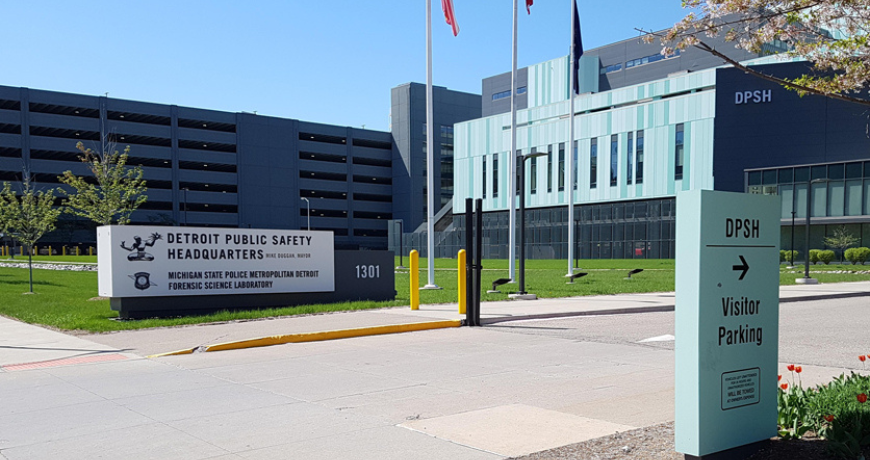
Mayor Mike Duggan and Chief James White have unveiled an unparalleled $3.1 million investment in state public safety funding. Both stating that this initiative will not only bolster policing capabilities but also address the mental health challenges that communities, especially Black neighborhoods, have faced, particularly in the wake of the pandemic.
Tuesday afternoon, Mayor Mike Duggan stood side-by-side with Representative Alabas Farhat, Representative Tyrone Carter, and Chief James White at a press conference to announce plans for a historic $3.1 million investment in state public safety funding.
Mayor Duggan proudly detailed how the investment will boost local policing capabilities, reduce vacancies in the force, and improve community relationships. This initiative comes on the back of a $10,000 pay raise that led to substantial improvements in recruitment, reducing vacancies from 300 to 150. The plan is to be fully staffed for the first time in many years by early next year.
This funding allots the hiring of 25 new officers contributing to a dual focus on law enforcement and mental health. A portion of these officers will work in the mental health unit and as neighborhood police officers, focusing on preventive measures.
The additional officers will be deployed to reinforce traditional public safety responses and prevention. Recent successes include curbing downtown shootings and breaking up illegal block parties that have been linked to mass shootings in other cities. With this increased ability to respond, the Detroit Police Department aims to keep the public even safer.
Reinforcing the Fabric of Community Policing: The essence of community policing lies in trust, collaboration, and mutual respect between law enforcement, residents, and community leaders. Detroit’s decision to deploy 14 new Neighborhood Police Officers (NPOs) is a testament to this belief. These officers are designed to engage in proactive and open dialogue, addressing the everyday concerns of residents – be it an abandoned car, a neighborhood dispute, or minor disturbances that doesn’t necessarily merit a 911 call but do impact our daily lives.
Chief White highlighted the importance of these officers, noting their role in addressing “those quality of life issues that don’t necessarily result in a 911 call but can make living in the city of Detroit… a bit more challenging.”
According to Duggan, homicides in the city are down 11%, and carjacking’s have decreased by 25% from a year ago. This is a direct result of having the necessary resources and leadership to tackle these issues. Duggan expressed his confidence in White, calling him “one of the great leaders in the country.”
The challenges of mental health, particularly in underserved communities, have been magnified by the post-pandemic reality. The statistics are alarming and according to White, the city’s response has been nothing short of determined. With 8667 mental health runs so far this year, compared to 7705 last year, and 899 suicides in progress, the urgency of this crisis cannot be overstated.
White acknowledged the weight of this crisis, saying, “We see that these things are here for us to deal with on a daily basis. We didn’t ask for this crisis. But this crisis is on our doorstep, and we have to effectively and professionally manage it.”
As we stand in the aftermath of a global pandemic, the challenges of mental health can no longer be whispered about in hushed tones. Mental health is real, and its effects have become ever more pronounced in our community. The COVID-19 pandemic exacerbated a crisis that was already brewing, leaving many feeling isolated, anxious, and without solutions. The surge in mental health issues during this period wasn’t just statistics on a page; it was palpable, affecting our families, neighbors, and friends.
The funding will also aid in hiring 11 mental health responders, recognizing that mental health is not just a crisis but an ongoing part of our daily lives.
Chief White says that the city has been steadfast, effectively and professionally managing this crisis, resulting in a “save rate” of 898 stopped suicides. The recognition that this is a part of our reality, and the determination to address it, speaks to the very soul of our community.
Contrarily, in a time when national conversations have often revolved around defunding police, Detroit’s choice to allocate a significant increase in funding to public safety can be seen as a notable departure. The decision is likely to draw varied reactions within the community. Some may view this as a critical investment in safety, community relationships, and mental health resources, acknowledging the unique needs and challenges our city faces. Others, especially those who have advocated for a shift in funding away from traditional policing, may question how these funds align with broader goals for community well-being, equity, and reform. The way this budget is implemented—and the transparency with which it’s handled—will no doubt play a significant role in shaping community response. Detroit finds itself at a crossroads, and the dialogue between city officials and community members will be vital in forging a path that reflects the diverse needs and voices of its residents—true Detroit residents.
“I am always concerned that law enforcement will do everything possible to ensure that they work in partnership with community organizations in pursuit of justice and peace,” said community leader Darryl Woods CEO/Founder of Fighting the Good Fight. “Defunding the police is not on the table however funding organizations that are working towards peace and justice is! We are in this struggle together.”
“Public Safety is vitally important for any city,” Woods expressed. “We need to ensure that we have every constitutional tool available for crime prevention and intervention!”
Duggan expressed that the new funding is not solely about traditional law enforcement. He emphasized, “This month we have started the CVI, the violence intervention group we call ShotSpotter. Those six organizations are out in the street today and are funded intervening with groups that tend to be beefing with each other, and we’re going to see the benefit of that.” Duggan’s expressions left the impression that this initiative seeks to actively engage the community and work at the grassroots level to prevent violence before it happens.
Of the six organizations, Force Detroit, Detroit 300, Detroit People’s Community and New Era Community Connection serving the city’s west side while Wayne Metro/Denby Neighborhood Alliance/Camp Restore and Detroit Friends and Family serves the east side.
In addition, State Representative Alabas Farhat spoke on an initiative that also amplified violence prevention measures, “The Violence Prevention and Public Safety trust fund is something we started working on back in June with the support of Speaker Joe Tate (D), Mayor Mike Duggan, and over nearly 40 of my colleagues in the Michigan legislature. And that’s something I’m looking forward to seeing move forward being accomplished and brought to the governor’s desk to sign because we have to increase funding opportunities for things like this.”
Tuesday’s speakers led with confidence that the historic $3.1 million public safety investment marks a transition toward directly enhancing the quality of life for Detroit residents.
“When I knocked the doors in my neighborhoods I’ll never forget where a lady on Piedmont Street in Northwest Detroit was telling the story of how she’s scared to let her grandkids play in her front lawn. This was back last year, she was scared of it,” said State Representative Alabas Farhat. “Now, I ended up getting in touch with some folks as there was an abandoned house on the block. And within a matter of two days, to testament to the sixth precinct, they were able to clear out an abandoned home that was being used for some illicit activity. And that’s a testament to this police force. And the way they’ve come to approach policing.”
City officials spoke to the fact that at the heart of our community is its people.