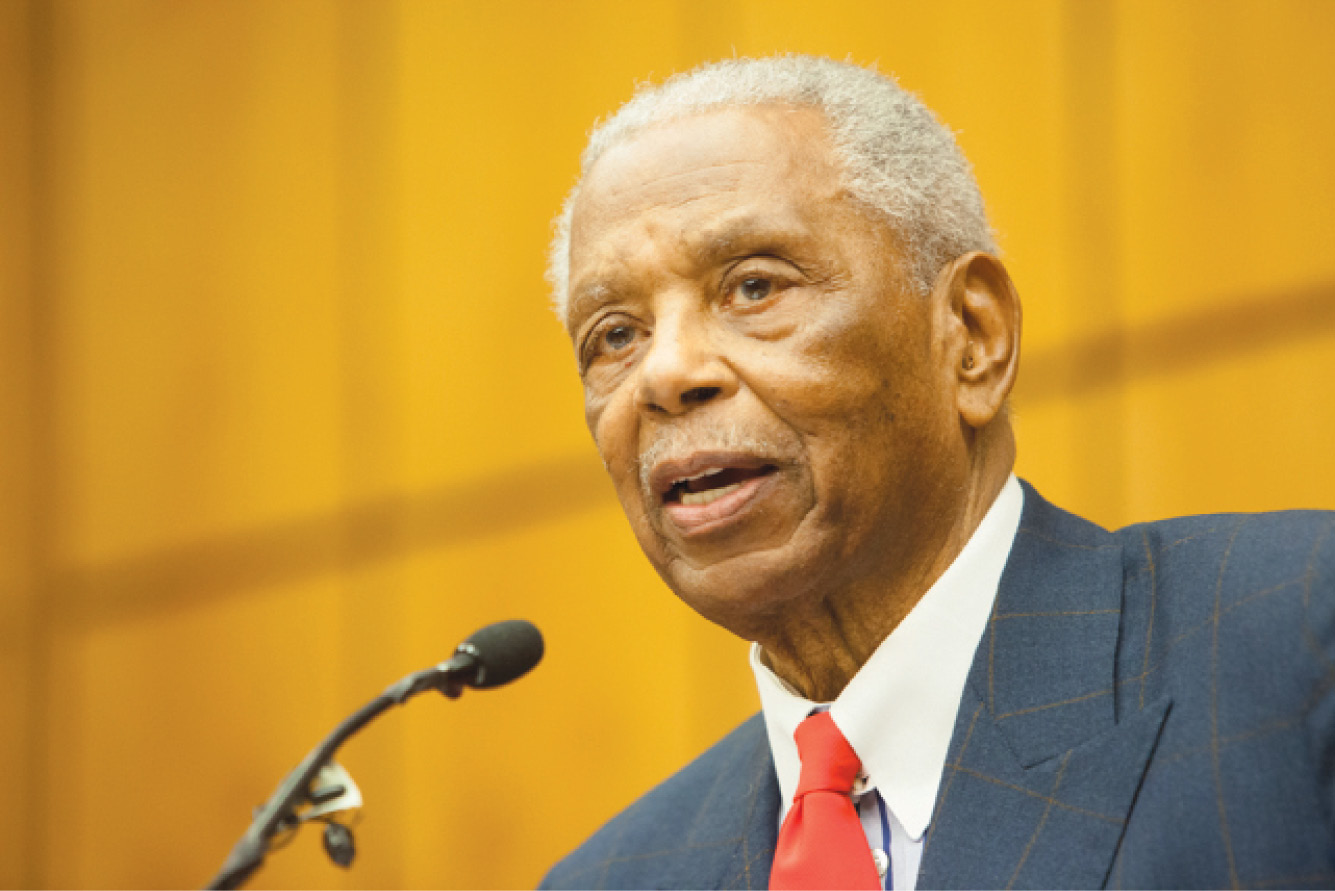
When stepping over the threshold of the Honorable Damon J. Keith’s downtown Detroit office in the Federal Courthouse Building, it’s difficult not to be impressed with the hundreds of photographs mounted along the walls of prominent people who have shaped movements, cultures, policies and the history of America over the last 60 years.
There are photos of Keith welcoming Nelson Mandela to Detroit, pictures with President John F. Kennedy at the White House, still shots with Rosa Parks, Thurgood Marshall, Colin Powell, Aretha Franklin, Lena Horne, Bishop Desmond Tutu, Willie Horton, Muhammad Ali, Coleman A. Young and countless more.
Upon walking deeper into the maze-shaped outer chambers and into the judge’s back chambers, there is a multiplicity of awards, honors, resolutions, framed historic news articles, earned and honorary degrees, as well as other cultural and legal artifacts, all systematically painting a picture of Damon J. Keith, who was appointed in 1967 to the United States District Court for the Eastern District of Michigan where he was elevated to chief judge. He was subsequently appointed to the United States Court of Appeals for the Sixth Circuit where he has served since 1977.
A lot can be learned about the native Detroiter’s incredible personal and public life by reading the new biography on the legendary federal judge titled “Crusader for Justice: Federal Judge Damon J. Keith.” Published by Wayne State University Press, the 368-page book, which contains 63 intriguing photos, depicts the amazing life of one of country’s most revered justices.
With major writing and editing contributions from Peter J. Hammer and Trevor W. Coleman, the book takes readers on a remarkable journey that started July 4, 1922, the date of Damon J. Keith’s birth.
“Crusader for Justice” gives readers tremendous insight into Keith’s life, as he reflects on his parents, upbringing, other influencers, educational decisions, major cases, views on civil and constitutional rights, significant American events, and his innate passion to empower all people, especially the underserved.
The book explores some of Keith’s most famous landmark cases, many of which were national news stories. Such cases included Davis v. School District of the City of Pontiac (1970) that ultimately led to total integration of Pontiac Public Schools.
It also gives readers much insight into the Hamtramck Housing Case (1971) where the judge’s findings and rulings were that the City of Hamtramck intentionally discriminated against Black residents and denied African Americans their rights under the Thirteenth and Fourteenth Amendments.
In this case, Keith also took the federal government’s Housing and Urban Development Agency (HUD) to task for its role in approving and funding urban renewal programs that negatively impacted Black people in Hamtramck.
“For the Department of Housing and Urban Development to direct, fund and foster programs that have harmed and, if unchecked, will continue to harm the Black citizens of Hamtramck, and to proceed with such activities by claiming innocence of what has been or is being done with federal funds cannot be tolerated,” Judge Damon wrote of his legal decision.
Perhaps Keith’s most famous case that had tremendous national significance was the one known as “The Keith Case.” This high profile case involved the judge taking on President Richard M. Nixon and U.S. Attorney General John Mitchell in 1971. Judge Keith ruled that Nixon was required to inform a Detroit-based group of anti-war activists whether he (Nixon) had engaged in warrantless wiretapping of the organization, under the claim of protecting national security.
According to “Crusader for Justice,” Nixon was so enraged at Keith’s decision that the president used a relatively unheard procedure of filing a writ of mandamus against Keith, which the judge wrote “was as close as you get, legally, to the president coming after you himself.”
The case went all the way up to the Supreme Court where the nation’s highest court affirmed Keith’s ruling.
“Crusader for Justice” also chronicles Keith’s reaction to the mayhem and destruction of the 1967 Detroit riot, which deeply touched his soul and troubled his spirit.
Additionally, the book describes his mentorship and legal guardianship of a young future superstar baseball player, Willie Horton. Horton’s parents asked Keith to become their young son’s mentor.
“I was flabbergasted,” Keith wrote. “Legal guardian meant I would be responsible for him in every way. I couldn’t believe they were asking me that. But they said, ‘Mr. Keith, we believe you can take care of our son. We trust you to watch out for his best interest.’”
While the entire book is filled with incredible stories and adventures that champion overcoming adversity, perhaps some of the most heartfelt parts are where Keith writes about the most important person in his life, his wife, Dr. Rachel Boone Keith.
Judge Damon Keith met Rachel in 1952, when he had just become the first Black attorney in Wayne County’s Friend of the Court. She was in the second year of her residency in internal medicine. The two were introduced by a mutual friend, Dr. Malcolm West who arranged for Keith and Boone to meet at the Herman Kiefer Health Complex where Boone was assigned.
“It was love at first sight, and a soulful connection that left me dizzy,” Keith wrote.
The two married in 1953 and went on have three daughters. Dr. Rachel Boone Keith passed in 2007.
Keith wrote, “Rarely do you find someone who has no parallel. Such a person was my wife of 53 years, Dr. Rachel Boone Keith. Her unique blend of beauty, brilliance, goodness and a servant’s heart put her in a class by herself. Without her support, I would not be a federal judge today. And without her love, I would not have known happiness all of our years together.”
“Crusader for Justice: Federal Judge Damon J. Keith” is a compelling book, one that should be required reading for anyone interested in how and why Judge Keith has powerfully impacted the fabric of America through his legal and social contributions, achievements and bold decisions.
“This book says a lot about the kind of difference one fellow being can make in this nation’s hunger for democracy and justice,” said Harry Belafonte, legendary humanitarian, civil rights activist and entertainer. “I wholeheartedly recommend this book for those who care about America’s future.”
About Post Author
