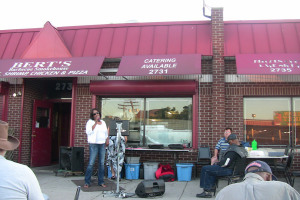
 As part of an all-hands-on-deck approach to saving Bert’s, the historic jazz club located in Eastern Market, Bert Dearing’s daughter, Melba, started a GoFundMe page on June 15 committed to raising $1.5 million before the building goes up for auction July 20-22 for a bid price of $700,000.
As of Sunday afternoon, 57 people have donated $2,035.
Unless a (very) heavyweight fairy godmother or godfather knocks on the door in the next few days carrying bags of cash and gold, it is clear that not anywhere near enough money will be raised in time to allow Dearing to buy back his business.
But giving up in the face of apparently insurmountable odds is one sure way to lose the fight, and this is not a fight that Bert intends to lose. It is also a fight that Detroit cannot afford to lose.
Said Chris Collins, artistic director of the Detroit Jazz Festival and director of Jazz Studies at Wayne State University, “Well, we must be very careful not to intermingle the verbiage and nomenclature of the corporate world with that of art. Art, jazz, creative music, these are living things. They are not corporate structures to be reviewed and updated according to the times.
“In fact, one of the things we should strive to do, as we develop to move forward in our corporate and structural ways, we have to make sure we make every effort, financially and otherwise, to provide the resources to sustain the parts of the legacy that shape us as human beings. Bert’s is a big part of that. Jazz is a big part of that.”
As a city that ranks second to no other municipality in the world as an overall music mecca, and as a city that has produced and/or developed more jazz giants per square inch than just about anywhere else except maybe New York, Detroit holds the troubling and perplexing distinction of the city with the most music that does hardly anything to promote or capitalize on it.
“I definitely think it’s a cultural travesty,” what is happening to Bert’s said James Carter, a Detroit native and famed jazz saxophonist whose roots are planted deep in Bert’s fertile tradition.
“Basically I kind of grew up musically in Bert’s when it was on Jefferson and Shelby back in 1983 when I was 14 years old. That’s how far I go back,” he said.
It was there he met the great Motown drummer Richard “Pistol” Allen and Detroit saxophone powerhouse Larry Smith. They both took the young Carter under their wing and a musical apprenticeship began to take shape that molded him into one of the world’s most renowned jazz saxophonists.
“It was like the tradition of Charlie Parker and Sonny Stitt lived on,” he said. “The thing about it is, it brings all of us together. We need things like this that are our cultural identification. Bert’s has always been the constant in this. Other places have come and gone. He’s always had something in the mix, and if there’s anything I can do to help, regardless of schedule, I’m there.
If Bert isn’t in there, it truly won’t represent a rebirth of Detroit.”
To understand the full impact of what it would mean for Detroit to lose Bert’s to “progress,” it’s important to take a look back and see what and who Detroit has already lost. Just this year we have lost jazz trumpeter Marcus Belgrave, vocalist Ortheia Barnes, vocalist Alberta Adams, and just last week we lost drummer Terry “Thunder” Hughley.
Hughley, whose packed funeral was held last Friday, followed by an equally packed memorial jam session at the Roostertail on Monday evening, was one of the best-known, most respected and beloved drummers in the city who has performed with a list of musical greats far too long to be mentioned here.
Adams, whose career stretched back to the Paradise Valley Days and who toured with the likes of Duke Ellington, Eddie Vinson, Louis Jordan, Lionel Hampton and T-Bone Walker, was revered as the Queen of Detroit Blues (the coronation of her successor, Thornetta Davis, is a much-anticipated event coming up in August).
Belgrave, along with being an internationally recognized talent, was a Detroit jazz institution. He was awarded the title of Detroit’s official Jazz Master Laureate, and in 2010 received a $50,000 Kresge Eminent Artist award for his nearly half-a century of service to young Detroit musicians.
Barnes was a longtime Detroit favorite vocalist who, although she didn’t quite reach the national or international acclaim of some of her peers, was widely respected and revered and sang with the likes of Aretha Franklin, who was a close friend, and Stevie Wonder.
This is what has been lost to the arts and culture of Detroit just this year alone. It is Detroit arts and culture that has long been the spiritual lifeblood of this city, and economically speaking as well, especially during the Paradise Valley Days, followed by the Motown era.
There is no reason why that can’t happen again. Just look at the resurgence of the Detroit Symphony Orchestra that has occurred under the seven-year tenure of musical director Leonard Slatkin. And look what that has done for Detroit, both economically and culturally. Prior to Slatkin’s arrival, the DSO was wheezing and on financial life support, barely able to keep the lights on, before enough people decided it was worth saving and the money started flowing back in.
In an article that appeared in the June, 2014 edition of Model D Detroit (full disclosure, yes, I wrote the article), Slatkin said:
“We are called the Detroit Symphony Orchestra. The name of the city is in our title. If we can continue to project positive energy, positive image, a sign that we are helping the city to bounce back, then that’s all to the good. And we can do that.
“Whatever we perceive in the recent upturn in the fortunes of Detroit, part of it is due to the fact that the orchestra, the leading cultural institution, stuck it out and wanted to become part of the solution in the city.”
But now, on the cusp of what is being heralded as a (this time for real) Detroit revitalization and comeback, Bert’s is being put on the auction block. And, for the record, Bert’s is a leading cultural institution too.
Those who were worried about the devil coming to town? Gisele Caver, a spokesperson for Bert’s, has confirmed that the planned (and controversial) unveiling of the Pagan goat-headed statue by the Satanic Temple, which was to be held at Bert’s on July 25, has been cancelled.
So, no excuses.
About Post Author
