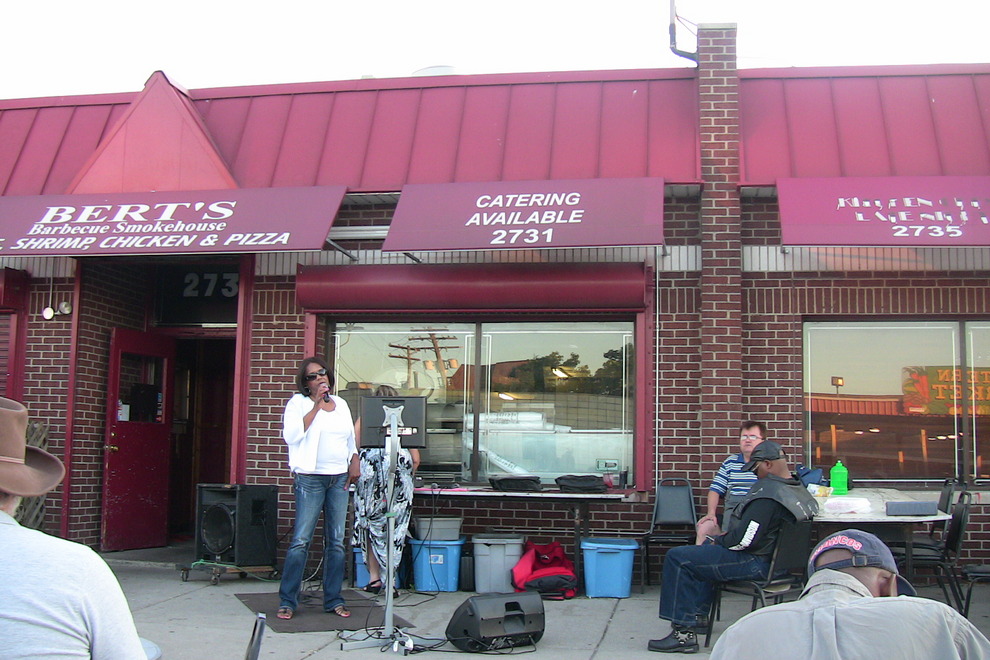
 This is a job for the people of Detroit. For nearly 30 years, Bert’s has been a cultural anchor that has served, saved, entertained, and employed thousands. Perhaps tens of thousands. While many may point to incoming businesses and new development as what is saving Detroit, a comparable argument could easily be made that it is small black businesses like Bert’s that have been saving this city for years.
“I don’t see why we can’t have progress while keeping some things in place. The problem I have is people trying to push him out,” said drummer GayeLynn McKinney, a 2014 Kresge Artist fellow. “But this is where the people come in, I hope, who come in and say hey, we want this to stay.”
So much of what has made Detroit a great American city is Detroit music, and Bert’s is synonymous with great American music, Detroit-style. No other city on the planet can compete with Detroit when it comes to musical legacy and global impact, and when it comes to Detroit jazz, which has produced some of the finest players in the world, there is hardly a single one of them who has not sharpened and refined his/her chops at Bert’s.
When the world’s best jazz musicians come through town, they usually end up at Bert’s after their “regular” gig to hang out, socialize and jam into the wee hours of the morning. This is a jazz tradition that stretches back nearly a century according to Ralphe Armstrong, one of the nation’s premier jazz bassists and a product of Cass Tech High School. Armstrong remembers playing his very first jazz gig at Bert Dearing’s first jazz club, the Black Horse Saloon, back in 1970. The club was located on Gratiot and Iroquois.
“Well, I don’t know all the details about what’s happening at Bert’s, but I do know what’s happening in Detroit,” said Armstrong. “They’re calling loans on a lot of businesses, and they’re doing this not just to him (club owner Bert Dearing) but to my dear friends the Pastoria brothers in Harmonie Park who owned UDetroit. They went down to Harmonie Park before anybody had anything in Detroit. Well they pulled that out.
“The banks called the loan. And they ran them out because everybody’s seeing green because the property is worth something in Detroit. And I believe they’re doing the same thing with Bert. But a big part of what draws people to Detroit is the culture, and if you destroy that, it’s going to fail. What’s going to lure them here?”
Bert’s is being put up for auction on auction.com from July 20-22. On June 9, an article appeared in Crain’s Detroit Business, which announced that the minimum bid for the 33,300 square-foot property, which includes nearly 20,000 square feet in parking space, will be $700,000.
Last Friday evening, at a fundraiser gathering of what appeared to be more than 300 in the audience at Bert’s Warehouse, the spirit of support for club owner Bert Dearing was strong. There was an impressive roster of talent lined up to keep the crowd entertained, but the focus of the evening was on keeping Bert’s right where it is.
Charles Brown, a retired Detroit attorney and a longtime regular patron of Bert’s as well as Baker’s Keyboard Lounge, expounded on how Bert’s has been much more than a musical destination.
“His support of grassroots and community events is enormous. It is like a Black community center, literally. … A couple of years ago (on January 17, 2010 for the South Carolina MLK Day Rallies), Mildred Gaddis organized buses of people to go and protest the Confederate flag in South Carolina. They met and left from Bert’s.”
Bert himself followed up on that theme later in the evening when he said, “I have Whites, Blacks, old and young all coming through here. They feel safe, they bring their kids, they listen and they learn. I think this fundraiser is creating a unity and an awareness about what’s going on. I got in bed with a snake. I just closed the lease deal in February (which goes through February 2017), and now they got it up for auction.”
Saxophonist Chris Collins, artistic director of the Detroit Jazz Festival and director of Jazz Studies at Wayne State University, emphasized the cultural cost to Detroit of losing Bert’s:
“The loss of any longstanding jazz club, especially one that has committed itself, not only to fine performances and great artists but to jam sessions and open mic nights and encouraging new artists to engage themselves with other generations and to intermingle is a great loss, not only to our regional community, but it would be a great loss to the global jazz community. When a venue has been around as long as Bert’s, it develops its own cultural imprint on the world of jazz.”
Adds Luther Keith, a local blues musician, Detroit Blues Society member and founder of ARISE! Detroit, “Bert’s is an intricate part of Detroit history. We need to do what we can to see that this important part of our city’s history, and the African American legacy, stays on the scene.”
Keyboardist Phil Hale co-hosts the Monday night jazz jam session at the Harbor House together with his brother, drummer Milton Hale. He credits Bert’s with being a key part of his music education.
“I learned to play jazz from going there and sitting in with those master players, and getting run off the stage after being allowed to go up but not being able to keep up. I continue to go there to this day, not just to learn but also to be there for others who are trying to learn,” he said.
“Bert’s sessions continue on as the great tradition in this town — now in the form of jazz, blues and R&B. To lose this great landmark would be a travesty, it would be tradition-breaking, and possibly the loss of the true jazz tradition in this town. When a place like Bert’s dies, so does the heart and soul of this community.”
Bert doesn’t plan on letting that happen.
“I’m not going nowhere,” he said. “The odds are always stacked against me, but some kinda way I always kick the odds to the side.”
About Post Author
