


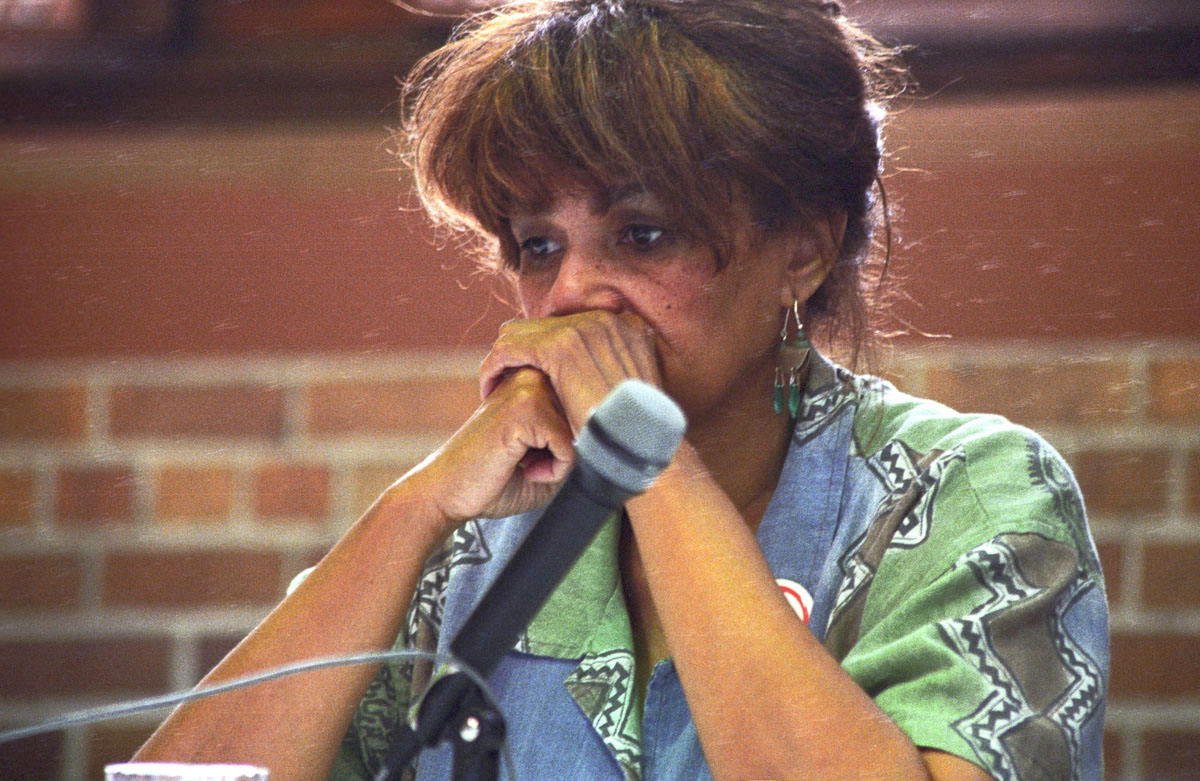
Detroit, MI–Mid-May 1998–Susan Watson, at a 1998 community summit meeting on the strike at Sacred Heart Seminary in Detroit, ©George Waldman
Special to the Michigan Chronicle
By: Keith A. Owens, W. Kim Heron, and Joe Swickard
Self-proclaimed giants are betrayed by the fact that they cast no shadows. Susan Watson never talked about her stature – she didn’t need to. Everyone who worked with her will tell you about the long shadow she cast in her profession and in her community.
Watson passed away Saturday at the age of 76, surrounded by family and friends at her Harper Hospital bed, ending a short pulmonary illness. Watson was a pioneer and trailblazer over her 30-year career as a Detroit Free Press reporter, editor, and columnist, and afterward as a labor activist and community advocate.
As a relative rookie reporter, and one of the very first African Americans in the newsroom, she was on the frontlines of the Free Press Pulitzer Prize-winning coverage of the 1967 Detroit uprising. She later teamed with fellow reporter Paul Magnusson to win a coveted Heywood Broun Award for a year-long investigation that revealed massive abuse and neglect of developmentally disabled children at a state facility. In another award-winning project, she went undercover with a small team of reporters, black and white – posing as everyday prospective homebuyers – to expose racial steering in the residential real estate business.
She won numerous other awards and was inducted into both the Michigan Journalism Hall of Fame and the Michigan Women’s Hall of Fame.
Named city editor in the midst of a to-the-hilt journalistic battle with The Detroit News in 1979 or 1980. Watson became the first African American and the first woman to lead a newsroom at a Detroit daily, and among the first of both groups to lead a newsroom in a major metropolitan city.
Watson lead drove, pushed and caressed her staff to coverage with wider, more caring eyes upon race and circumstance. She wanted officials and wrongdoers held to strict accounts while demanding stories that spoke of the individuals and people and not mere names caught in the public glare. Among her signature achievements as city editor was a 14-day series involving 30 staffers that surveyed African American life in Detroit, from politics to business to sports, from the Underground Railroad to the Great Migration, to becoming the majority and finding political power in the 1970s.
Her passion continued as a metropolitan columnist beginning in 1984 – and along with writings on politics and news, she revealed a more personal take on events, often by sharing the life and growth of her son Allen, aka The Seeker of Wisdom and Truth.”
Her love affair with the Free Press ended in the bitterness of the 1995 newspaper strike. She walked out to become a prominent strike leader — and there would be no reconciliation.
Born in Detroit on May 19, 1943, to Horace Hermann and Susie Perry Holmes, Watson grew up in the close-knit community of River Rouge and attended River Rouge High School. She graduated from the University of Michigan Honors College in 1965.
Watson is survived by her son, Allen Watson, daughter-in-law Patricia L. Watson; step-grandsons Mikyle and Spencer and her cousin Debbie Harper of River Rouge.
To understand her greatness, you need only listen to the words of those who knew her:
- W. Kim Heron (Free Press reporter, music writer, and copy editor, Detroit Sunday Journal managing editor): Susan’s writing is so good that it’s hard to read her without envy, without hoping to cop a move or two, without wanting to be better. She had a sense of history and perspective – and she could land a punch with grace. She was part of a generation of African American reporters who integrated heretofore all-white daily newspapers in the 1960s, and she was likewise a pioneering woman in a city newsroom where women had always been severely underrepresented. It’s hard, to sum up how trailblazers like Susan influenced the profession for a more complete rendering of our times.
- Judith Diebolt (Free Press reporter and editor, also Detroit News editor): She was an unflappable reporter and a master storyteller. If you look at the most important Detroit stories beginning with the 1967 Detroit Uprisings through the mid-1990s, you will find Susan Watson’s fingerprints on them. She was either covering those stories as a writer and columnist or guiding the coverage as city editor of the Free Press. She was a woman of wit, wisdom and great personal style.
- Tom Schram (Free Press reporter, Detroit Sunday Journal editor): Susan was the face of the 1995 newspaper strike and an unquestioned moral force. Walking the picket line without Susan was a completely different experience than when she was there. When Susan was absent, yelling at the scabs and line-crossers usually resulted in nasty verbal exchanges. Physical confrontations would sometimes occur. When Susan was present, the scabs shut their mouths, put their heads down and kept walking as she gave them her silent look of disdain. Picketing with Susan was like attending Mass with the pope.
Thanks to Susan, The Detroit Sunday Journal was fiercely independent. It was a unique experiment in journalism, created and owned by the striking unions. Shortly after we began publishing, a former Free Press colleague who had moved on to a newspaper in New York emailed me and asked what would happen if the unions tried to force us to print something that we did not want to print. I emailed back: “Do you really think any union official is going to tell Susan Watson how to run a newspaper?” A few minutes later I got a three-word reply: “Yeah, you’re right.”
- Darren Nichols (Detroit News reporter): Susan Watson introduced me to newspapers. I was about eight years old and a classmate and friend with her son Allen. I saw Allen’s mom plastered on newspaper boxes all over Detroit.
Mrs. Watson quietly helped guide my path into journalism. It wasn’t until years later I realized she helped secure a visit to her alma mater (with a basketball player as my host, knowing I wanted to be a sportswriter) and was the person behind Wayne State’s persistence in pursuing me saying that I came “highly recommended by people at the Free Press”.
To say her death is a loss is an understatement. It’s like losing a family member or a second mom. I owe my career to her, and knowing I’ve come anywhere close to hers shows her influence on the next generation was not in vain.
- Khary Kimani Turner (Coleman A. Young Center executive director): I graduated high school with Ms. Watson’s son, Allen. He’s my brother, which means I knew her by her greatest work before I learned of her occupation. She later became a model of professionalism and consistency when I became a journalist. She honored Detroit and its people through her work, and many of the city’s best writers consider her a barometer when assessing their pedigree. I pray for her family’s comfort, and for just commendation of her spirit. Standing ovation, Ms. Watson.
- David Lawrence (former Free Press executive editor and publisher, who promoted Susan):
Back in 1979 the iconic movie actor John Wayne died, and we put out a special section extolling him. Susan Watson was the top person on the city desk, and afterwards she made it clear that we used a lot of newsprint on a man who was a terrible racist and worth no honest praise. She was right then, and so often. We were fortunate to have her professional skills and her vigorous energy on behalf of what was fair and just. She was a teacher of us all. A wonderful teacher. - Jack Kresnak (Free Press reporter): Susan was one of the most influential colleagues I ever had at the Free Press. Her writing inspired me, but it was her point of view, as an African American journalist, that I valued. She was a key part of the Freep’s coverage of the 1967 riots. As an editor, she had a way of questioning reporters’ perceptions and prejudices that led to better coverage of racial issues, particularly those related to crime and justice. One of the saddest results of the disastrous 1995 newspaper strike was losing Susan Watson who never returned to the Free Press staff. She was missed.
- George Waldman (Free Press photographer): Susan and I became pretty close during the strike, two of a core of about six editorial people left at the end of the four years of the Detroit Sunday Journal. My deepest feelings about her is that she had just about the strongest power of will I have ever known. And a clear intellect and a righteous sense of ethics.
- Keith A. Owens (former Detroit Free Press editorial page writer and Michigan Chronicle Senior Editor): Susan Watson was the best Detroit had to offer, not only as a towering journalist and writer but as an activist and human being who taught others the true meaning of service. Because anyone who read a Susan Watson column knew that she was not just sharing random thoughts, she was providing a public service.
Details on services to be announced.