


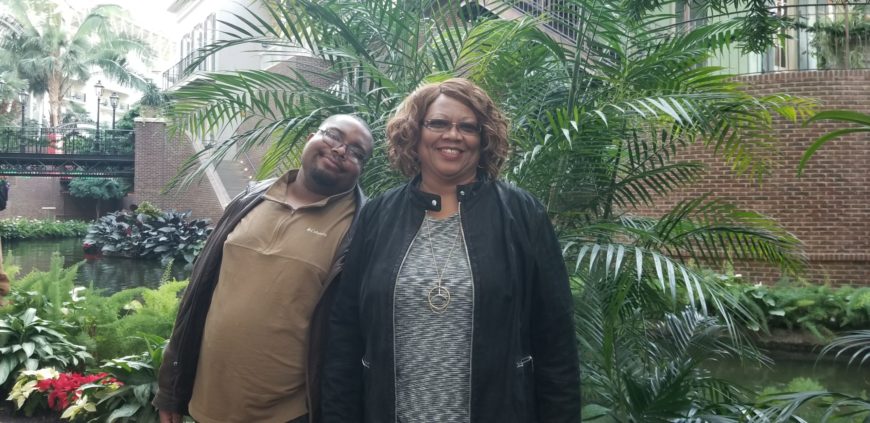
Autism Alliance of Michigan Outreach Manager Joanna Lofton, the parent of an adult son, Edward, who has autism, helps families and communities of color who are facing challenges on their autism journey.
Photo courtesy of Joanna Lofton
There is no cure for autism, but early prevention is key to this neurological and medical disorder that affects one in 68 children in the U.S., according to the Centers for Disease Control and Prevention (CDC) statistics.
It also affects Black families more dynamically with sometimes slower diagnosis timing, misdiagnosis, lack of treatment plans, and lack of medical care compared to white counterparts.
The CDC reports that Black and Hispanic children are also less likely to be identified with autism spectrum disorder.
“These differences suggest that Black and Hispanic children may face socioeconomic or other barriers that lead to a lack of (or delayed) access to evaluation, diagnosis, and services,” according to the website.
The state of Michigan is now the fifth-largest autism population (as compared to other U.S. states in 2007), according to the non-profit organization Autism Alliance of Michigan (AAoM).
The autism spectrum disorder is a lifelong neurological disability that is marked by significant social communication and behavioral traits. This disorder’s severity can vary widely from one individual to another. The term “spectrum” refers to this range of social-communication and behavioral deficits, according to www.michigan.gov.
Annually in April, the advocacy charity organization Autism Speaks recognizes World Autism Month, beginning with United Nations-sanctioned World Autism Awareness Day on April 2. Throughout the month, the organization concentrates on sharing stories and creating safe spaces to deepen understanding and acceptance of people with autism, fostering worldwide support, and more, according to their website.
Autism is the fastest-growing developmental disability in the nation, which reaches boys four to five times more often than girls, according to the National Institute of Mental Health Online.
However, even with worldwide recognition, there are significant disparities still across the board, impacting Black youth and adults who have autism.
Colleen Allen, president, and CEO of AAoM told the Michigan Chronicle that some disparities in treatment delays can be accounted for because of complex systems surrounding autism, not to mention the challenging layers of Medicaid.
“From the state level to local community mental health (there are) differences in processes and intake and maybe you get someone who knows how to help a family get through that,” Allen said adding that the Alliance’s goal is to help with the “hand-holding,” process to empower families most in need. “That is our goal and we do that at no cost we … need to get to those hard to reach.”
A Mother’s Love
AAoM Outreach Manager Joanna Lofton, also the parent of an adult son, Edward (diagnosed with autism at 2 years old) told the Michigan Chronicle in an exclusive interview that it’s an uphill battle she’s learned to fight in the case of her 30-year-old son and for other Black families who experience disparities in the day-to-day.
Lofton said that her son was diagnosed early primarily because of other physical ailments (including having seizures) that needed more rigorous medical intervention, which not everyone has access to.
“Communities of color tend to be much later (diagnosed),” Lofton said. “We stay way behind. … There is a lag in actual treatment for people of color and some of it we know has to do with families not going in as early in our community.”
Facts on autism provided by AAoM:
- Approximately 16,590 children in Michigan public schools with Autism. (MDE2012)
- Parents who have a child with autism are 2%-8% more likely to have another child with autism (CDC Online).
- Estimated lifelong costs for those with autism depending on system support will exceed $3.2 million (CDC Online).
Lofton said sometimes historically-based fears surrounding some Black communities regarding of treatment are valid because of past wrongs committed by the medical community during slavery and beyond including CDC-led syphilis experimentations with the Tuskegee Airmen between 1932 and 1972.
“We have our own reluctance to contact the medical professionals and once we do there is that perception that our kids are OK or our kids are going to grow out of it,” she said, adding that the Alliance’s goal is to change that narrative and then some. “Really, our goal empowering those families (so) that they don’t need forever.
“It is really a lifelong disability and that is the issue that families don’t understand how to navigate that system.”
She added that despite the reasons behind a lack (and lag) of treatment, she wants families to know when they do come in that – while the earlier the better – it’s never too late to be seen.
“We have some 60-year-olds we have worked with,” she said of the Alliance.
Keeping Them Safe
Lofton added that another layer to this medical complexity is helping keep Black autistic youth safe, and their families, amid fears for police brutality and more.
“For many of our families it is more about keeping them safe because we have those other inherent issues… fear of … not knowing what is going to happen to our children,” Lofton said adding that she worries every time her son walks out the door. “If it hadn’t been for the Alliance … he would not be doing as well as he is doing.”
Recently, AAoM launched a three-year education and engagement campaign to heighten statewide health and wellness opportunities for individuals in Michigan’s autism community, as part of a new, 10-year strategic vision, according to their Facebook page. This campaign also marks the 10th Anniversary of Landmark Autism Insurance Reform, which transformed Michigan from being ranked as one of the 10 worst states to raise a child with autism to being ranked among the best.
The organization is also hosting its annual fundraiser Michigan Shines for Autism Gala Saturday, at 6 p.m. to midnight on April 23 at the Motor City Casino, which is open to the public with tickets still available as of press time.
“The fundraiser allows us to do this great work,” Allen said adding that monies raised from the annual event helps reduce the age of diagnosis and allows for more inclusive equality education.
AAoM Clinical Specialist and Navigator Manager Jill Matson told the Michigan Chronicle that with a background as a pediatric nurse working in the field (for about 20 years) she is passionate about bridging the gap between communities of color and rural populations who don’t always have easily accessible treatment.
“Some of the strategies we’ve used here at the Alliance is with some of our efforts and endeavors we have often looked for populations where there were a lot of these gaps and services and what we could do to partner with these and increase awareness and do some advocating for minority families and families of color,” Matson said, adding that the biggest thing for these communities to know is that the Alliance is a tool, especially its navigator program staffed with professionals who have extensive experience. “Every treatment plan is going to be individualized really focusing on areas of concern or improving skills.”
In Michigan, the Great Start Program offers Early On® as a resource for infants and toddlers from birth to three years of age with developmental delays and/or disabilities. Early On® can be reached at Early On at 1-800-EarlyOn (1-800-327-5966) or www.1800EarlyOn.org.
The Autism Alliance of Michigan’s fundraiser, Michigan Shines for Autism Gala, is Saturday, April 23, and presented by the DTE Foundation. For more information on the fundraiser visit Autismallianceofmichigan.org.
For more information visit https://autismallianceofmichigan.org/2022-gala/.