

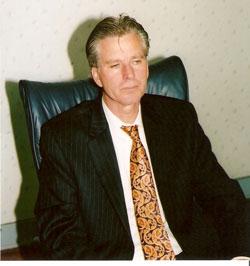

Democratic candidate wants diversity on ticket…
State House Majority Leader Andy Dillon (D-Redford) argues that his experiences both in and out of government make him the best choice to be Michigan’s next governor.
He said he comes in with 20 years private sector experience, 10 of them working directly for or with troubled businesses.
“I’ve been fighting in Lansing for the last five and a half years,” he said. “And as speaker I know I’ll hit the ground running because I’ve been dealing with the struggles of the budget directly for the last three and a half years.”
He reiterated that he brings the private sector piece he believes Michigan will need. He also said the state is fixable.
Dillon acknowledged that voters are frustrated and that they want someone in office who will work in a bipartisan way, which he says he has done.
“Most of the big initiatives you’ve seen done in Lansing, I was in the middle of,” he said. “That would be the 21st Century Jobs Fund, the energy reform, the pension reform we just did for K-12. When you see me announce something like a public employee health care plan that will save $1 billion a year, I mean I’m hardly embracing the status quo. I’ve been kind of the guy who’s been pushing Lansing to change. And that’s where the voters are.
Voters want bipartisanship. When need be, to stand up against special interests. That’s my reputation. I don’t have to change who I am to sell that to the voters.”
Dillon sees three big problems for the state: a complicated tax; a regulatory environment that isn’t user friendly; and a perception that Michigan is a hostile state because of labor tensions.
“A lot of what labor’s doing — they’re training their people, they’re investing in them — if you look at a lot of big construction projects, union shops are on time, on budget. They get done because they invest in training people.”
He added that a recent meeting with Bob King (UAW vice president and director of the National Ford Department) was encouraging because the launch of the Taurus was the best quality driven launch in the history of Ford, if not the auto industry overall.
“He was telling me there were about three or four battles that they had, UAW with management at Ford,” he said.
Dillon’s number one goal as governor would be jobs. He said 50 percent of all job loss in the country in the last ten years has been in Michigan.
“We’ve gone from a top 20 per capita income state to a bottom 10,” he said. “So we’ve had some really serious tough times here. But I look at it and say, how do we fix this?”
His answer: Michigan has a lot of assets it can build on. He cited four.
Despite the job loss, Michigan is number two in the country in research and development investment. He said the knowledge-based economy is sitting right here in Michigan and that it’s the pipeline for middle class jobs of the future.
Second, agriculture is the state’s second biggest industry. Dillon said it’s a $70 billion industry. He believes if the state spends one-third of the time it spends fighting to protect its manufacturing base on fighting to grow agriculture, that will lead to job creation.
Third is tourism. Dillon said Michigan has great assets and quality of life offerings, including the Great Lakes, golf, skiing and the arts.
Fourth is the skilled workforce industry and existing infrastructure.
Dillon also said we need to get all our economic engines coordinated and focused on a 10-year vision.
“So that when we’re recruiting businesses to come to the state, or when we’re working with businesses already here, there’s a one-stop shop so that we cut through a lot of the red tape.”
The other critical piece, according to Dillon, is that the state won’t turn around without the cities turning around. He said he has a comprehensive 12-point urban agenda plan.
“It’s access to jobs; it’s access to transportation; it’s access to health care; it’s public safety in the neighborhoods; it’s making certain that kids have access to a good education,” he said, adding that his administration will have a cabinet-level position responsible for the urban agenda.
“We’re going to meet every two weeks because I want an update,” he said.
Dillon also said the regional transit authority has to happen, but we won’t solve our mass transit problem if we let every city opt in or opt out.
He spoke to Mayor Dave Bing, Oakland County Executive L. Brooks Patterson, Wayne County Executive Robert Ficano and Macomb County Commission Chair Paul Gieleghem at the recent Detroit Regional Chamber Mackinac Policy Conference, and said they need to follow up on that meeting, get everyone in the room, cut the deal, and pass the legislation that will create the authority.
Asked if he would pick an African- American lieutenant governor, Dillon said, number one, he would pick the best candidate.
“Two, I think part of the criteria for who is the best candidate is to make certain the Democratic ticket reflects the state’s population, and reflects the diversity our state has,” he said.
He pointed out that he is “very much” thinking his lieutenant governor pick would be an African American, but added that it is not a promise.
Geography would be another factor in Dillon’s decision.
He would also “absolutely” be willing to listen to advice about governing from his Republican predecessors, John Engler and William Milliken, if any were offered.
“You’ve got to learn from people that have been there,” he said. “I do it now as speaker. I go to people that have been around Lansing’s government for years, from both sides of the aisle, because I’ve got a Republican senate to work with.”
As governor, Dillon would meet on a regular basis with the Senate Majority Leader, the Speaker of the House, and the minority leaders of both chambers.
Photo Credit, Patrick Keating.